Why Irish Sunrises Glow: The Science Behind the Colour
I am usually awake before the countryside begins to stir. If I notice the first trace of colour through the window, there is every chance I will wander outside—sometimes still in my pyjamas—to see what the morning is preparing.
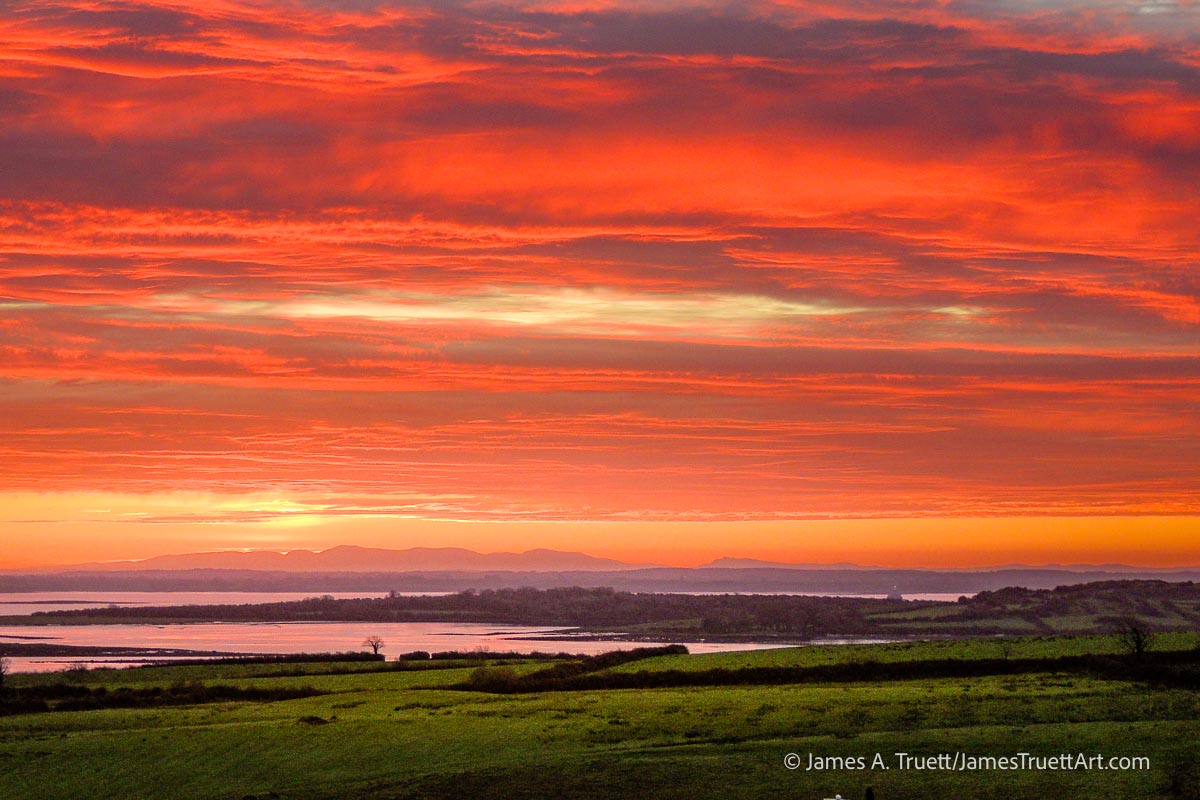
Here in County Clare, that preparation can be remarkably elaborate. A narrow line of amber may appear above the Shannon Estuary. Within minutes, it spreads into crimson, coral and soft violet, illuminating the undersides of clouds and laying bands of colour across the water.
If the conditions look promising, I reach for my camera. On other mornings, I launch the drone and watch the light begin to touch the rooftops, fields and shoreline from above.
The entire performance may last only a few minutes. That is part of its attraction. Nothing can be postponed, repeated or precisely predicted.

The Same Sun, a Different Painting
Sunrises have fascinated me in very different parts of the world. I have watched the day arrive from boats in Mexico and Miami, where the light rose from broad horizons and warm water. Ireland presents the same celestial event with an entirely different temperament.
The skies here seldom feel empty. Cloud, mist and rapidly changing Atlantic weather give the sunlight something to work upon. Even when I photograph from the same place on successive mornings, the result is never quite the same.
One sunrise may arrive in quiet layers of peach and grey. Another may send red light racing across broken clouds. On a misty morning, the landscape seems to emerge gradually, with trees, hills and water appearing one plane at a time.
They are distinctive brushstrokes across the canvas of a morning sky—but what actually creates all that colour?

Why Dawn Turns Red and Gold
Sunlight looks white, but it contains the full visible spectrum of colour.
When the Sun is high overhead, its light takes a relatively short route through the atmosphere. Tiny molecules in the air scatter the shorter blue and violet wavelengths more readily than the longer red wavelengths. That scattered blue light is what gives us a blue daytime sky.
At sunrise, the geometry changes. The Sun is close to the horizon, so its light must travel through a much greater depth of atmosphere before reaching us. Much of the blue and violet light is scattered away from the direct beam along that extended journey. The longer wavelengths—the yellows, oranges and reds—are more likely to remain visible.
This process is known as Rayleigh scattering. It is related to the size of the molecules interacting with the light, but it is not the same process that forms a rainbow. A rainbow is created when light is refracted, reflected and separated into colours inside water droplets.
Dawn is less like sunlight passing through a glass prism and more like a long atmospheric filtration. By the time the light reaches County Clare, its palette has changed.

Why Ireland Supplies Such a Fine Canvas
The underlying physics is the same everywhere, so there is no separate law of nature reserved for Irish sunrises. Ireland does, however, offer a compelling combination of conditions.
Our weather is strongly influenced by the Atlantic Ocean. Humid air, passing fronts and frequent changes between cloud, showers and clearer intervals are familiar parts of life here. Met Éireann notes that Irish skies are completely cloud-covered for well over half the time.
That may sound discouraging to a sunrise photographer, but an entirely clear sky is not always the most interesting one.
Broken layers of cloud can catch and redistribute the reddened light. High and middle clouds may remain illuminated while the lower countryside is still in shadow. Corrugated cloud undersides form alternating bands of brightness and darkness, giving the colour texture and depth.
Mist adds another dimension. It softens distant hills, separates the landscape into layers and makes the early light visible in the valleys. Haze, sea salt, smoke and other suspended particles can also alter the intensity and character of the colours. Their effect is complicated: some particles strengthen reds and golds, while too much haze can mute or obscure the display.
In autumn and winter, the Sun follows a lower path across the Irish sky. The light remains oblique for longer, while fog, frost and unsettled weather offer additional surfaces on which it can work. This helps explain why so many of my most vivid County Clare images have been made during the colder months.

The Sun That Appears Enormous
The rising Sun sometimes seems much larger when it sits beside a distant hill, tree or building.
I once described the atmosphere as a kind of magnifying glass, but that is not quite what happens. Atmospheric refraction can bend the light and slightly flatten or distort the solar disc near the horizon. It does not significantly enlarge it.
The sensation of a giant Sun is chiefly an illusion of perception. Our minds judge it against familiar features along the horizon, making it seem larger than the same solar disc in an otherwise empty sky.
The camera introduces its own interpretation. A long lens compresses the apparent distance between foreground and background, allowing the Sun to dominate a landscape photograph even more strongly.

When Light Breaks Through
Some of my favourite mornings begin with a bank of dark cloud and only a few narrow openings.
Sunlight passing through those openings creates the bright columns commonly called sunbeams, or crepuscular rays. The rays are essentially parallel, although perspective makes them appear to spread outward like a fan. Mist, haze or fine particles in the air make their paths easier to see.
From the drone, those rays can appear to tickle the countryside—lighting one field, one stretch of water or one corner of Kildysart while everything around it remains subdued.
That selective illumination gives the landscape a sense of theatre, yet the ingredients are wonderfully ordinary: sunlight, air, water, cloud and the position of the observer.

Carrying the Morning into My Work
When I am photographing a sunrise, I often feel transported into a different world. Time seems to stop because there is no room to think about anything beyond the changing light.
Later, while editing the photographs, I enter that moment again. I notice transitions that happened too quickly to absorb outdoors: a faint seam of blue between the oranges, the reflection trembling in a tidal pool, or a patch of land briefly selected by a sunbeam.
That fascination eventually became my book, Sunrises of County Clare, a collection of mornings photographed around the estuary and countryside. It also led to my Abstract Irish Sunrises, in which the colours and movement of dawn are softened, stretched and interpreted through intentional camera movement and post-processing.
The science helps me understand what I am seeing, but it does not diminish the experience. If anything, knowing that an immense sequence of light, atmosphere, weather and perception has converged for a few fleeting minutes makes me pay closer attention.
Tomorrow’s sunrise will be made from the same basic ingredients. It will still find a way to be entirely its own.
To continue the journey, explore my book Sunrises of County Clare and the artworks in my Abstract Irish Sunrises series.