Irish Mist: Where the Road Disappears
There is something about an Irish mist that changes more than the view.
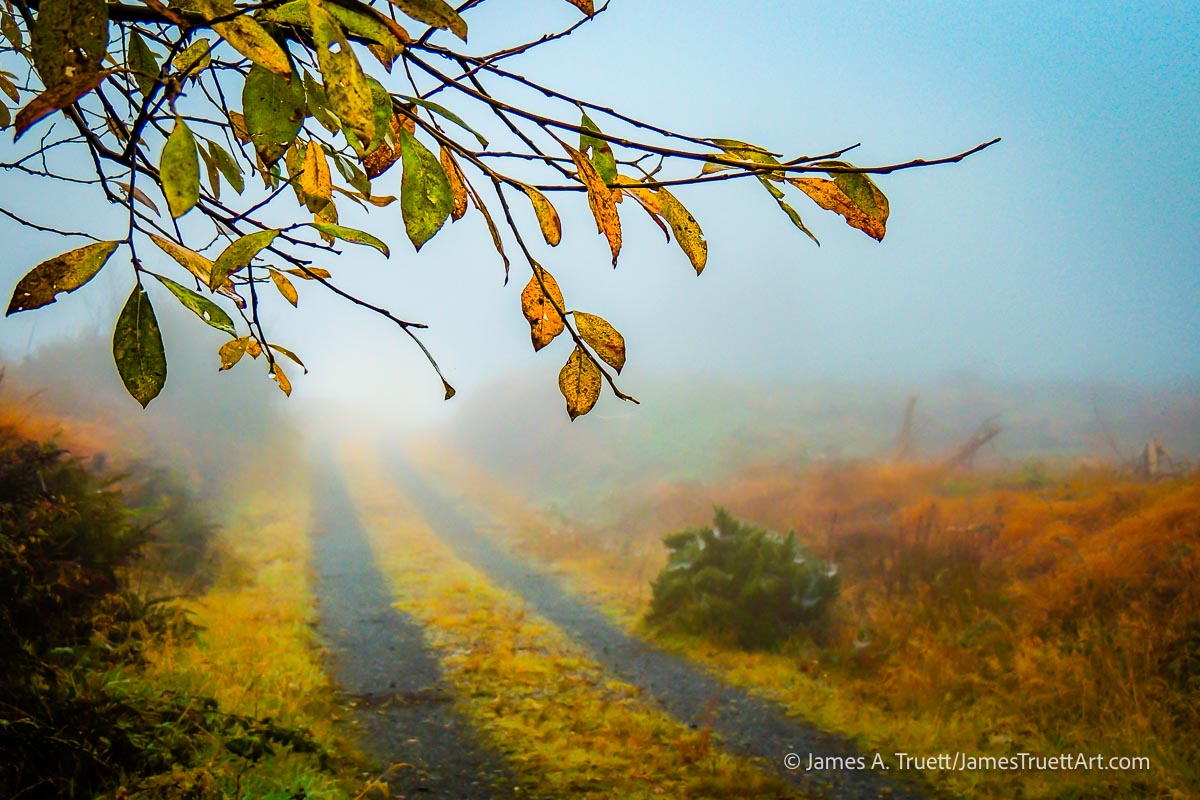
On a clear morning, a County Clare boreen tells you where it is going. The hedges mark its edges, the next bend waits ahead, and distant hills give the road its place in the wider landscape. Then the mist arrives and quietly removes all that certainty. The road may continue for another mile or disappear around a gate twenty paces away. You walk more slowly. You notice more.
For me, the feeling rests somewhere between haunting and magical: the mystery of not knowing what lies beyond, balanced by the grounding thought that my ancestors walked these paths before me.

When the Landscape Draws Near
Irish mist does not simply hide the countryside. It edits it.
A row of trees becomes an island floating above a valley. A fence runs confidently across a field and then vanishes. The sun, still low on an autumn or winter morning, filters through suspended droplets and spreads a pale orange or buttery yellow light across the meadows. Familiar ground becomes a study in layers—dark hedge, silver air, faint hill, then nothing.
Meteorologists distinguish mist from fog by visibility: fog is dense enough to reduce it below one kilometre. Both are made of tiny water droplets hanging close to the ground. Around the rolling country of Clare, the veil often gathers when damp air near the land cools to its dew point on a calm night. Cold air can also settle into hollows and valleys, which helps explain why the mist traces the shape of the land so beautifully.
Ireland’s Atlantic climate supplies abundant moisture and moderates the temperature, but no single meeting of “Gulf Stream air” and Arctic air creates every misty morning. The conditions are more local and more varied than that. Clear skies, gentle winds, wet ground, cool nights and the contours of the countryside all play their part. In November, when the sun is low and weak, the mist can be particularly slow to lift.
Science explains the droplets. It does not diminish the experience.

A Boreen Without a Horizon
The Irish word bóithrín means a small country road. In County Clare, these boreens are often narrow enough to make two approaching drivers conduct a quick negotiation, but on foot they invite an entirely different pace.
I think of a little road through Lanna, the townland where my great-grandparents once farmed. In summer, its hedges carry wildflowers. In autumn, leaves gather in gold, green and rust. Under mist, the road loses its horizon and seems to lead as much into memory as into the next field.
These backroads always make me wonder about the souls who travelled them over hundreds of years. They carried turf home from the bog, visited neighbours, went to Mass, brought news, told stories and sang songs. I cannot know what any particular ancestor thought along a particular bend. What I do know is that the land beneath my feet is not abstract family history. It is the same ground.
When the distance disappears, that connection feels closer. The empty road is not silent. Wind moves through the trees, a bird calls from somewhere beyond sight, and in the imagination there are old melodies travelling through the branches.

The Aroma of Fireplace Weather
Mist has a scent in the Irish countryside—or, more accurately, the mornings I remember most often pair it with one.
During autumn and winter, a sweet, earthy trace of turf smoke drifts from cottages warming against the chill. I have long called this “fireplace weather.” Perhaps that affection began during my childhood in Interior Alaska, where warmth and shelter were never merely decorative ideas. Even now, the glow of a fire is comforting and slightly mesmerising.
Turf, or peat, formed from plant material accumulated in waterlogged bogs over thousands of years. For generations it was cut, dried, carried home and burned for cooking and heat. Saving turf was family work: the sods were turned, then stood upright—or “footed”—so sun and wind could finish drying them.
That history gives the aroma emotional weight, but affection should not prevent clear sight. Peatlands store carbon, and turf smoke contributes harmful fine particles to the air. The practice is fading and changing for good environmental and health reasons. Still, scent is a powerful keeper of memory. A trace on a cold morning can call up the hearth, the bog and generations of rural life in an instant.

Photographing What the Mist Reveals
Mist has followed my work for years. It appears in the sunrises of Mystical Moods of Ireland: Enchanted Celtic Skies and in the rural scenes of Magical Irish Countryside. I have photographed it around Lissycasey, Decomade, Kildysart, Lake Knockalough, Coole Park and the Shannon Estuary.
Sometimes the photograph begins with patience. Sometimes it begins in pyjamas.
One October morning, I spotted a magpie perched on my backyard fence above Lissycasey, with the mist layered behind it. I grabbed the camera and slipped outside, leaving eggs boiling on the stove. The photograph, Magpie in Morning Irish Mist, survived the expedition beautifully. The eggs became hard and rubbery.
That is the bargain of changing light: it will not wait while you finish breakfast.
In other images, the mist carries a deeper stillness. Autumn Mist at Killone Lough, from my Impressionist Ireland series, softens the boundary between water and land until the scene feels suspended between present and past. The artwork was exhibited at ArtExpo New York and later in Berlin in 2025. Its muted light expresses what continues to draw me to mist—not concealment alone, but connection.

What Remains When the View Disappears
A clear landscape encourages the eye to travel outward. Mist turns it inward.
It removes the grand view and leaves a gate, a branch, a few yards of road, the nearest sound and the next footstep. For an artist, that is a useful reminder. Beauty is not always waiting at the far horizon. Sometimes it is the small portion of the world still visible when everything else has vanished.
And so I keep walking the boreens when the Irish mist comes down. I know it will lift. The hills will return, fences will reconnect with distant fields, and the road will once again declare where it is going.
For a little while, though, the way ahead remains hidden. The air carries the countryside close around me, the trees hold their music, and the footsteps of the past feel nearer than the next bend.
View Autumn Mist at Killone Lough and explore the story behind the artwork.