Dough Castle in Lahinch: A Ruin Built on Sand
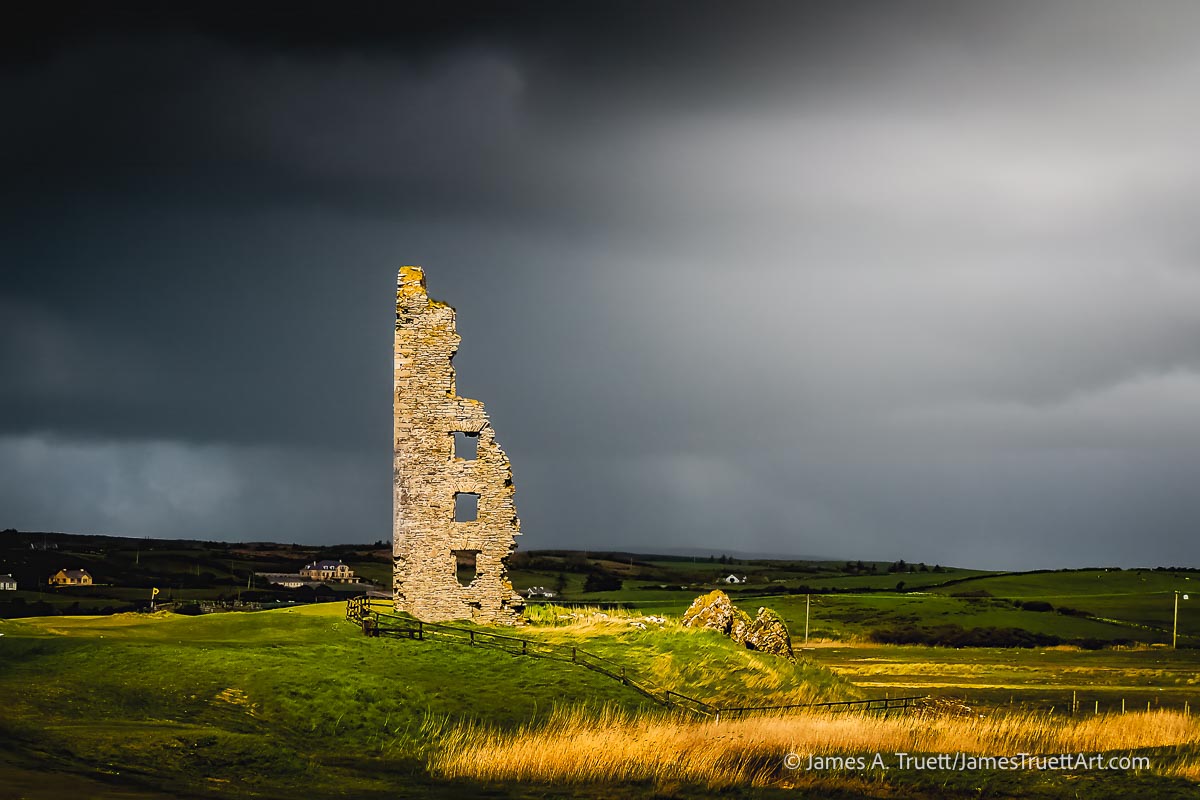
The sky had turned almost black over Lahinch, yet the storm had not quite won the afternoon. A shaft of sunlight found its way beneath the clouds and fell across the remains of Dough Castle, lighting the old stone while everything behind it receded into shadow.
It was the sort of moment that makes me stop.
From the road north of Lahinch, the castle is easy to see. It stands near the meeting of the Inagh and Dealagh rivers, within Lahinch Golf Club, where golfers pass a medieval ruin during an ordinary round. Ireland has no shortage of broken towers, but there is something distinctly curious about this one. The surviving wall looks both commanding and improbable, as though it has been left standing to remind us how little control any building has over the ground beneath it.
A Stronghold on Uncertain Ground
Dough Castle takes its name from Dumhach Uí Chonchúir, meaning the sandbank of the O’Connors. The name is unusually honest about the castle’s central problem.
The O’Connors, lords of Corcomroe, established a stronghold here in the early fourteenth century. Its position near the mouth of the Inagh River gave it strategic value, allowing its occupants to watch movement by land and water. References to a castle on the site date to 1422, although the fragment standing today belongs to a later structure.
By 1584, Dough Castle was held by the family of Sir Donal O’Brien. It escaped the deliberate destruction that claimed many Irish strongholds during the Cromwellian period when Colonel Stubber intervened to spare it in 1654. A description from 1675 records a tall, battlemented tower with a two-storey house attached.
War did not bring the castle down. The sand did.
Sections collapsed at different times, particularly during the nineteenth century. One side had fallen before 1839, and another substantial portion, including a chimney, came down in 1883. Today, little more than one great wall remains. That any of it survives seems remarkable; that people repeatedly built and rebuilt on such uncertain foundations seems even more so.
Golfers, Ghosts and the Fairy King
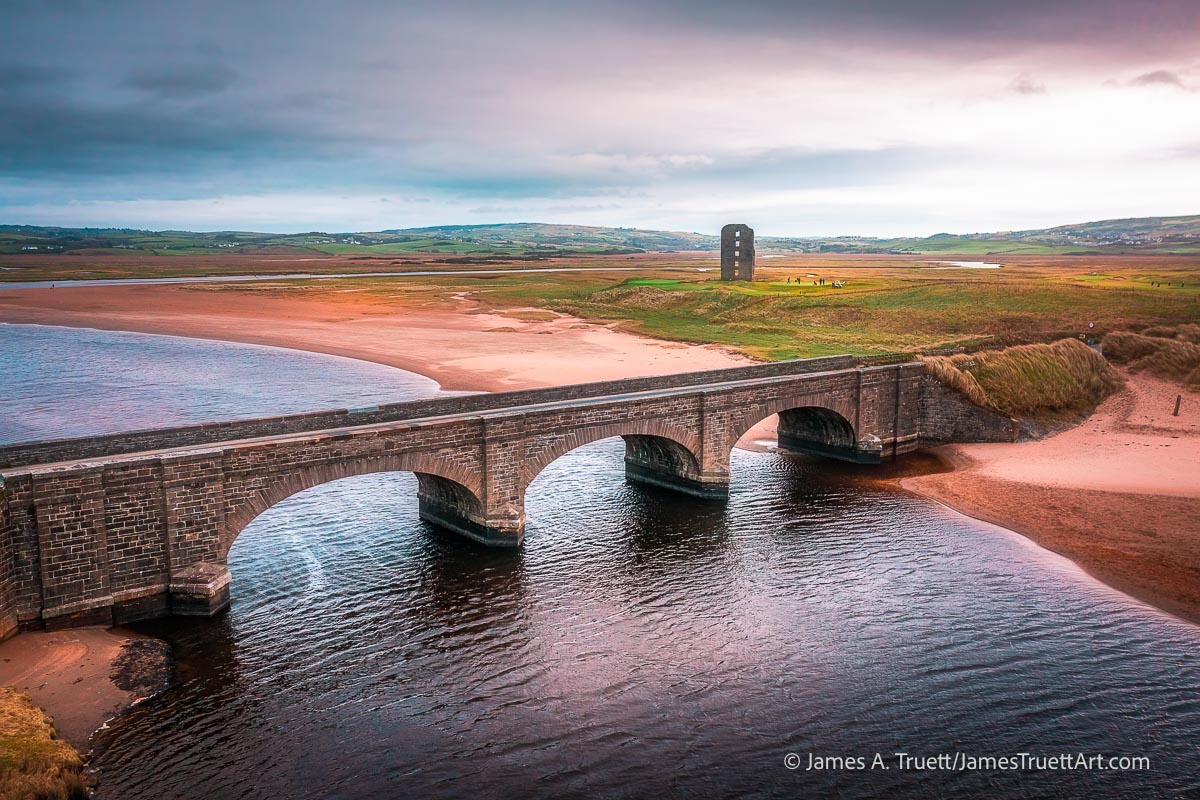
The setting makes the ruin stranger still. Dough Castle now stands beside the seventh hole of the Castle Course at Lahinch Golf Club. Golfers measure their shots while a battered remnant of clan history watches from the edge of the fairway. The contrast should feel incongruous, but in Ireland, where the past is so often woven into the working landscape, it somehow feels natural.
There is another explanation for the castle’s troubled state, if unstable geology seems too ordinary.
Local tradition names the surrounding sand hills as the haunt of Donn Dumhach, the Fairy King. Such stories rarely need to compete with history; they occupy a different layer of the same place. The engineer may point to the foundations, while folklore quietly asks why anyone expected a fortress built on a fairy king’s sandbank to remain undisturbed.
Standing there beneath that brewing storm, I could appreciate both versions.
When the Light Found the Ruin
What I remember most is not a date or a clan name, but the light. The castle was already an arresting shape, isolated against the sky, yet that brief illumination changed it. The dark clouds gave the wall weight and drama; the sunlight revealed the warmth held in the stone.
That was the moment the scene became more than a record of an old Irish castle. It became a study in endurance.
Dough Castle survives not as its builders intended, but as time, weather and unstable ground have allowed. Its incompleteness is what makes us look. Through the missing walls we see the sky; around a former stronghold we see people at play; beneath a story of power we find the simple fact of sand.
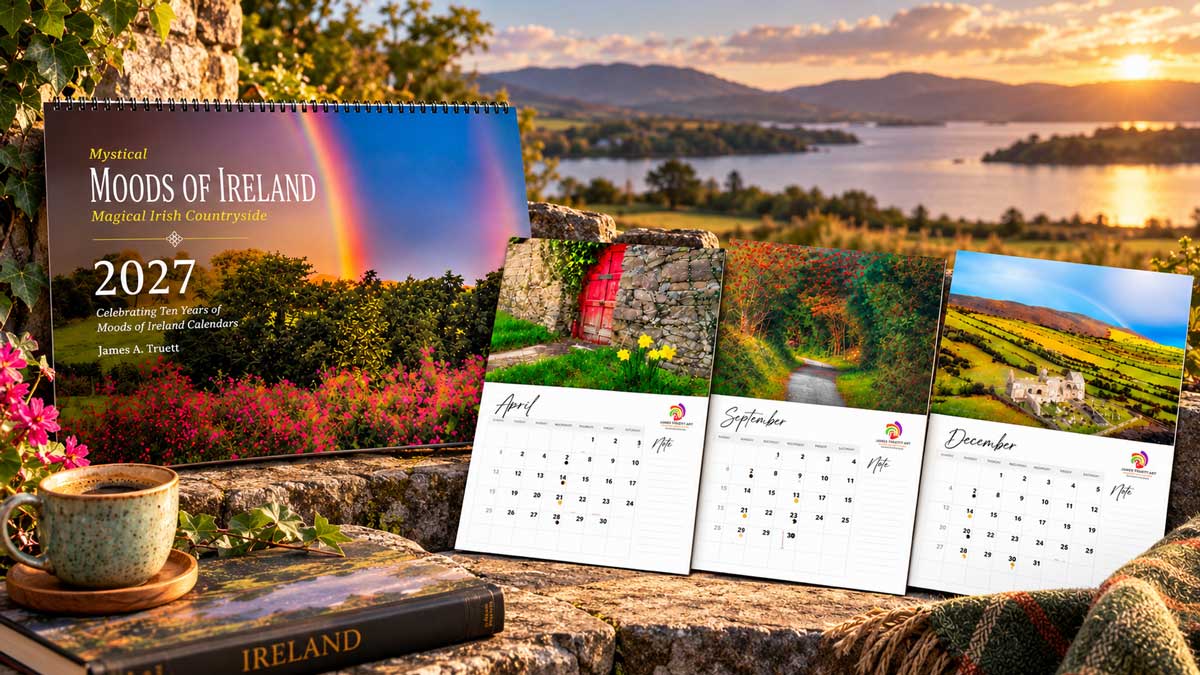
My photograph of that afternoon appears in Magical Irish Countryside, the third volume in my Mystical Moods of Ireland series. I included it because the image holds the tension I felt at the scene: darkness gathering, sunlight lingering, and one improbable wall refusing to disappear.
Perhaps that is why ruins continue to draw my attention. They ask us to notice what remains without pretending nothing has been lost. Along the road beyond Lahinch, Dough Castle offers that invitation in a single weathered wall—and, on the right afternoon, in a sudden passage of light.