Doonagore Castle: Where Beauty Meets a Darker History
There are places I return to because I have not finished seeing them.
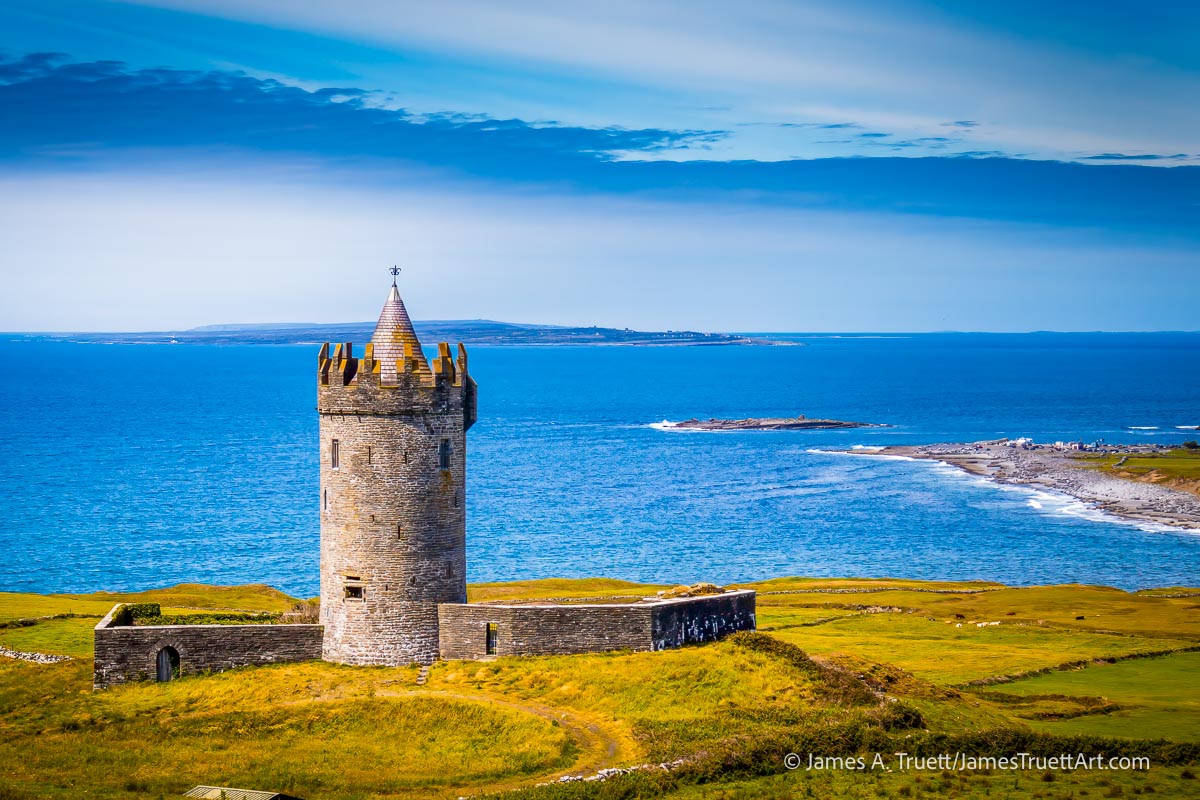
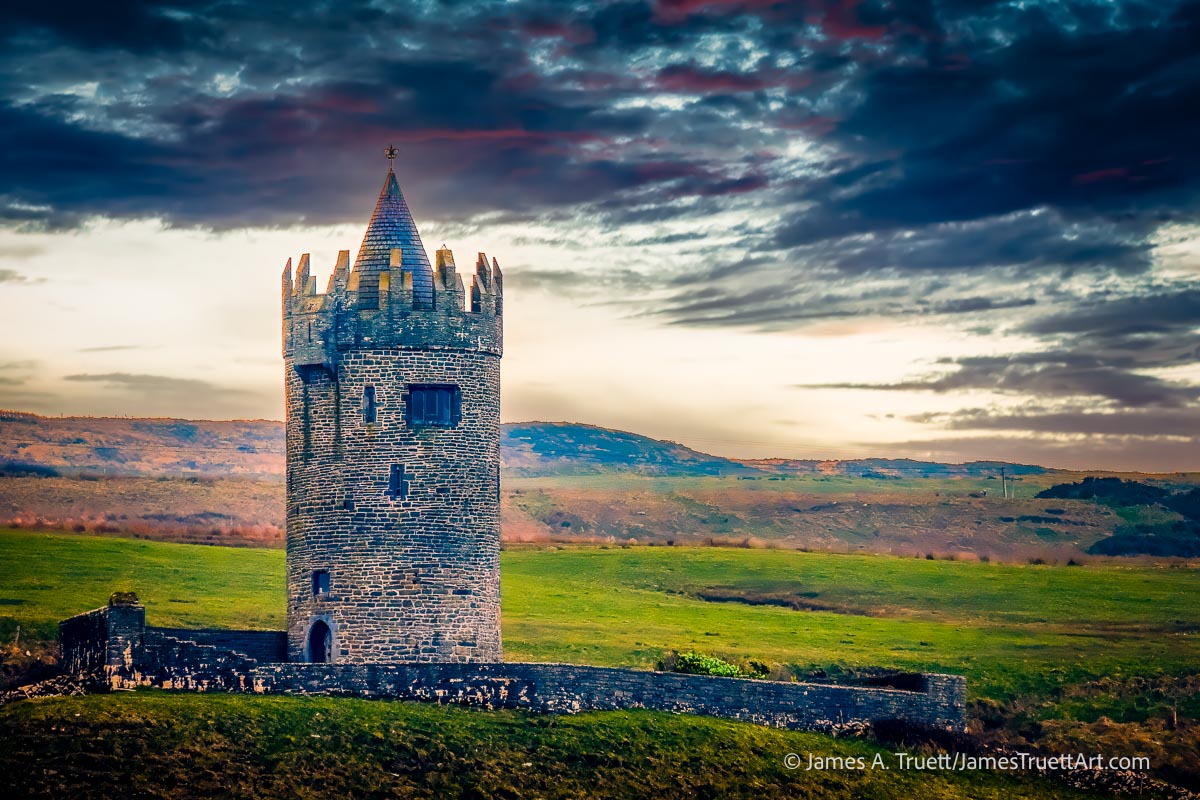
Doonagore Castle is one of those places. It stands on a rise just south of Doolin in County Clare, its round stone tower and enclosing wall set plainly against the Atlantic sky. From a distance, the shape is so clean and self-contained that it can look almost like an emblem of Ireland: castle, green fields, restless weather and the sea beyond.
But the scene never repeats itself.
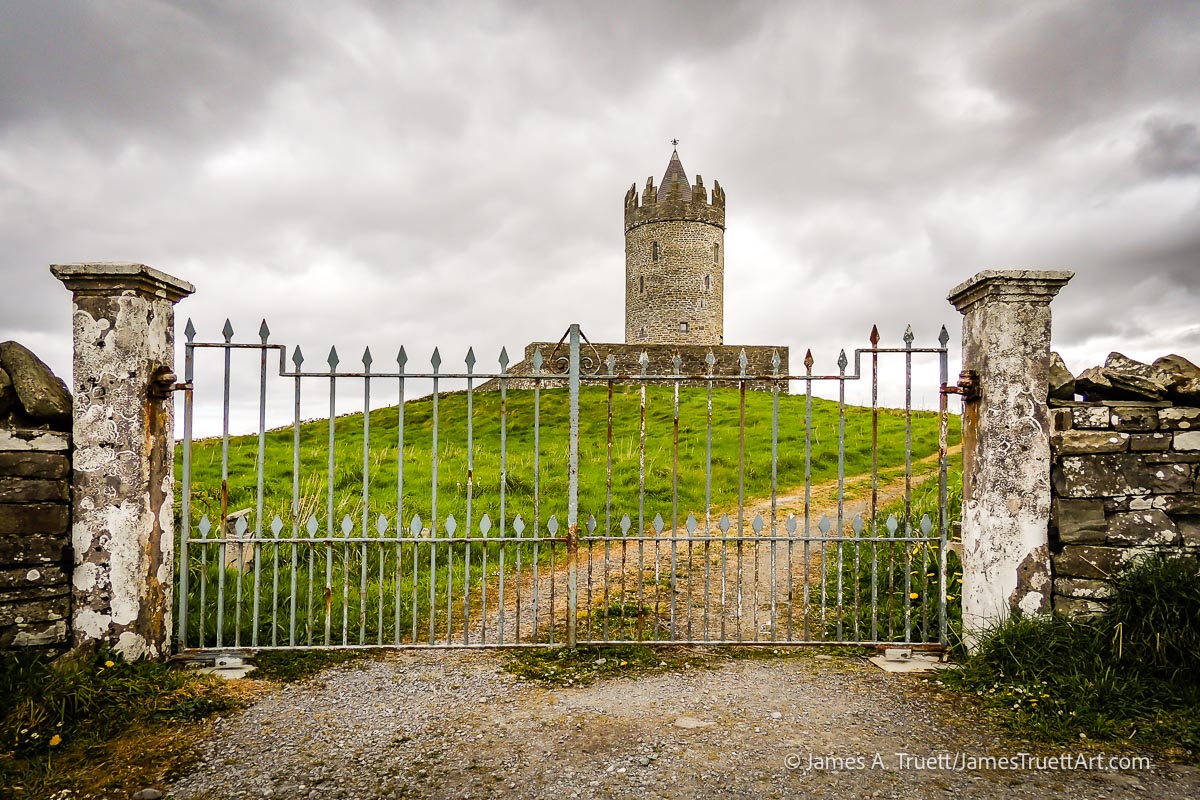
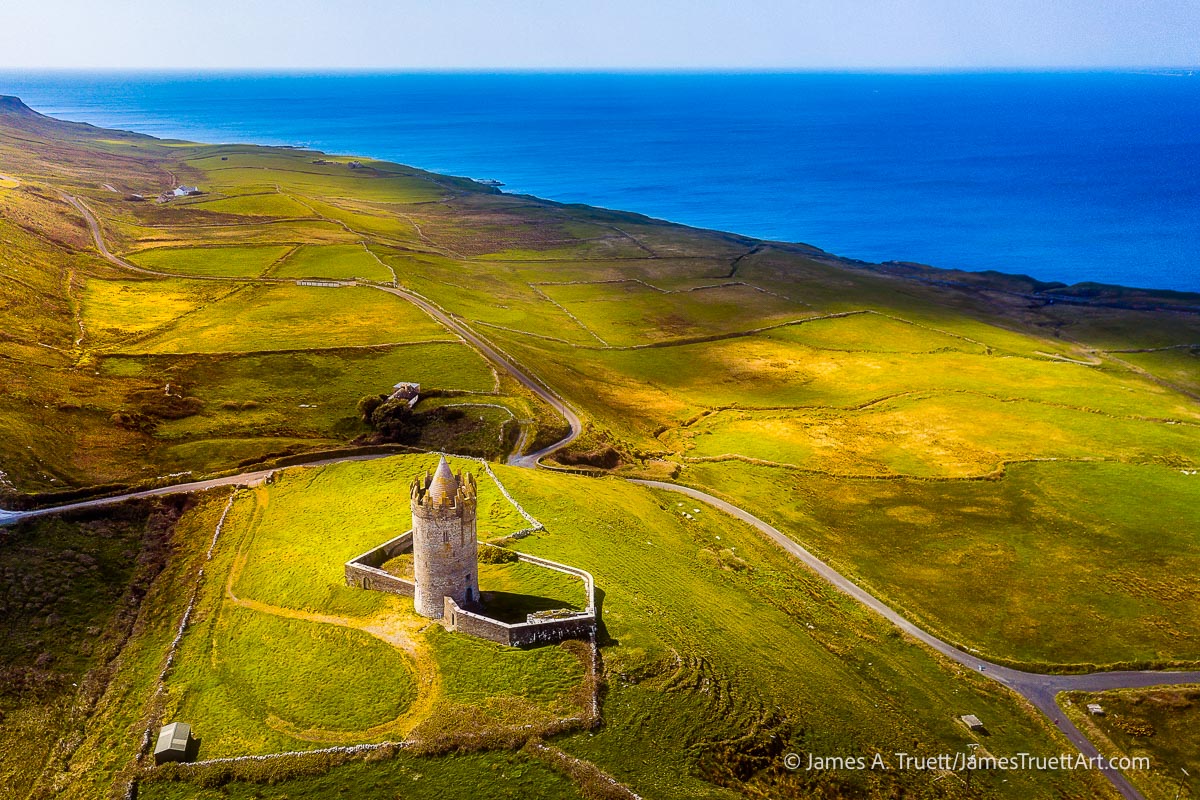
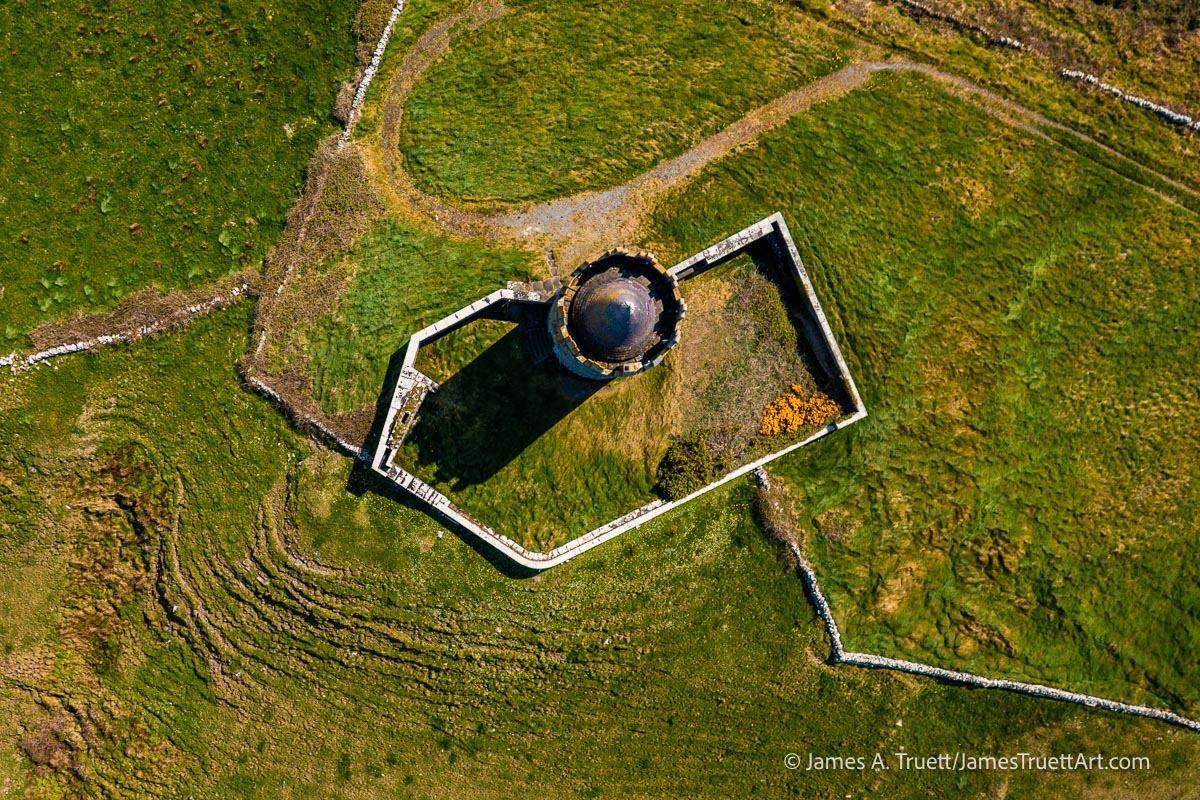
I have photographed Doonagore from nearly every angle, including from the air, and each visit has given it a different character. On one day the tower may be sharply drawn in clear western light. On another, it seems to withdraw into mist. Clouds move quickly here. Sunlight crosses the fields in broad patches, and the Atlantic can change from silver to slate while you are still deciding where to stand.
That constant change first drew me to the castle. Its history is what made me look again.
A Round Tower Above Doolin
Doonagore is a 16th-century tower house, built close to the site of an earlier fort. Unlike the square or rectangular tower houses seen across much of Ireland, it is cylindrical—one of only a few round tower houses in the Burren region. Its walls are mostly sandstone, with limestone used for some of the finer details.
The tower originally contained four floors above a cellar. A surrounding bawn wall created a small defended enclosure, while a projecting stone feature above the doorway allowed the entrance to be protected from the wall walk. These practical details are easy to miss when viewing the castle from the road. From a distance, architecture designed for defence has softened into a graceful silhouette.
The name is generally linked to the Irish Dún na Gabhair, though translations vary between “fort of the goats” and “fort of the rounded hills.” Both seem at home in this landscape.
The castle is privately owned and is not open to visitors. In a way, that distance has become part of my experience of it. I do not think of Doonagore as a building to tour room by room, but as a presence in the wider landscape—a fixed point among changing skies, fields and sea.
The September of 1588
The most troubling chapter in Doonagore’s story began far beyond County Clare.
In 1588, the Spanish Armada’s attempt to invade England failed. As ships made the long return journey around Scotland and Ireland, Atlantic storms drove many onto the western and northern coasts. Wrecks were scattered across hundreds of kilometres of shoreline, and thousands of sailors died at sea or after reaching land.
In September, an Armada ship was wrecked near Doolin. About 170 men are said to have survived the sea, only to be captured by Boetius Clancy, the High Sheriff of Clare and a member of the family then associated with Doonagore.
The surviving accounts do not agree on every detail. Some place the executions at the castle; others on a nearby ancient mound remembered as Cnocán an Crochaire—Hangman’s Hill. The precise location matters to historians, but the human truth is stark wherever it happened: men who had somehow escaped a wreck on a violent coast were put to death soon afterwards.
Standing above the Atlantic, it is difficult not to imagine the confusion of that night—the noise of timber breaking, shouted voices lost in the wind, and exhausted men reaching shore with no idea of what awaited them.
Looking Beyond the Silhouette
This knowledge changed the way I photographed Doonagore.
The castle still catches the eye. It would be dishonest to pretend otherwise. Its rounded tower, high position and open setting have a visual simplicity that photographers naturally respond to. Yet beauty does not erase what happened in its shadow.
That was my real moment of discovery here: a landscape can hold admiration and sorrow at the same time.
When I arrive with a camera, I watch the light as I always have. I notice how the tower stands against a bank of cloud, how a break in the weather warms one field while the next remains dark, or how the sea appears and disappears behind rain. But I also think about those sailors—frightened, far from home, and caught in events much larger than themselves.
The history does not make the view less beautiful. It makes looking at it less casual.
A Castle Restored, a Story Retained
Doonagore passed through several families and eventually fell into disrepair. It was repaired in the early 19th century, declined again, and was restored in the 1970s under the direction of architect Percy Le Clerc. Today its carefully restored form is familiar to anyone who travels the coastal roads around Doolin.
What remains with me, however, is not only the structure. It is the tension within the scene.
On the Clare coast, weather is always revising the landscape. Light arrives, vanishes and returns somewhere else. Doonagore Castle stays in place while everything around it moves. Perhaps that is why I continue to photograph it. Each image can show the same tower, but never quite the same story.
Some places reward a quick glance. Others ask us to remain a little longer and allow the first impression to deepen. Doonagore does that for me. It reminds me that seeing beauty everywhere does not mean turning away from sorrow. Sometimes it means looking closely enough to hold both.