Dangan Castle at Ballynacally: Centuries in One Garden
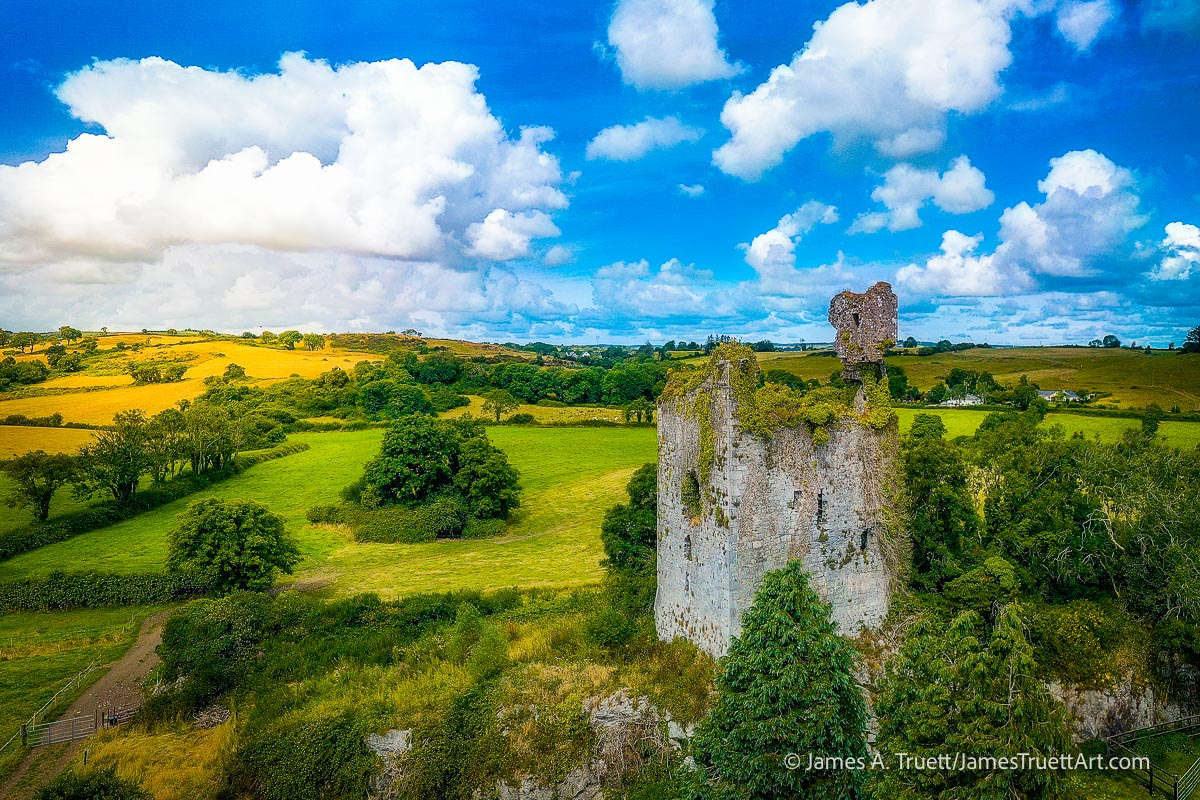
At the entrance to Ballynacally, the past does not announce itself with a gatehouse, a visitor centre or even a sign asking you to stop. It rises behind a private home, above a lovingly maintained flower garden, with working farmland stretching around it and the Shannon Estuary only a short distance away.
That is Dangan Castle.
The first thing I notice is not its size but its unlikely place in the everyday landscape. Modern houses sit beneath walls raised centuries ago. Flowers bloom where a fortress once projected authority. At the top of the ruin, a surviving piece of masonry appears to balance precariously against the sky.
I have photographed Dangan in different seasons, and that contrast continues to draw me back. There is something mysterious about seeing an old castle maintain its watch over modern homes—not isolated from life, but folded into it.

A Castle in Someone’s Backyard
Many Irish ruins stand at a picturesque distance, separated from the present by lawns, fences or carefully managed grounds. Dangan is different. It is on private property, quite literally part of someone’s backyard.
That setting makes it feel less like a monument and more like a neighbour.
The resident’s garden brings colour and care to the foreground. Beyond it are stone walls, fields and the broad estuary landscape. Above everything stands the ivy-covered shell of the castle. Hundreds of years are compressed into one view, yet nothing seems arranged for effect.
This is what first interested me as an artist and photographer. The scene contains what I once described as “contrasting timelines”: the fortified past, the domestic present and the seasonal life of a garden sharing the same small patch of County Clare.

The Stronghold on the Rock
The name Dangan comes from the Irish daingean, meaning a stronghold or fortress. The word suits the site. County Clare’s local-history records describe the castle as standing on solid rock that, on three sides, is scarcely wider than the ruin itself.
Historic references call it Dangan-moy-builc or Dangan MacMahon. A 1570 list of County Clare castles records “Dangin” about half a mile north of Ballynacally, then with four walls and in good condition. By 1580, Dangan-moy-builc was associated with Teige MacMahon of Clonderalaw.
Older descriptions—including some of my own—called Dangan a Norman tower house. More specialised research identifies it more accurately as a Gaelic tower house dating from the sixteenth century, closely connected with the MacMahons. That distinction matters. It places the ruin within the network of Gaelic lordship that shaped this part of west Clare rather than treating every tall stone castle as a Norman building.
Its position near the Shannon and Fergus estuary system also explains why the castle feels inseparable from the wider landscape. This was never an empty edge of the map. The waterways carried travellers, traders and raiders, while castles and tower houses marked territories and guarded the interests of the families who controlled them.
History and Folklore
Stone ruins invite stories, especially when written records leave so much unsaid.
In the 1930s, the Irish Folklore Commission’s Schools’ Collection preserved a Ballynacally story about treasure hidden at Dangan Castle. The account tells of a tunnel running beneath the castle towards another ruin on Deer Island and of gold concealed within Dangan itself. Another local tradition claimed an evil spirit guarded the treasure.
These are not facts to be confused with the documented history, but they belong to the life of the place. A ruin survives not only through masonry and official records, but through the stories people tell when passing it from one generation to the next.
Perhaps that is why the broken tower can feel so present. Its roof is gone, and its rooms are open to the weather, yet imagination continues to furnish them.

The Image That Stayed with Me
Over the years, several of my photographs of Dangan Castle appeared in Facebook posts and on my earlier journal. One image became the December feature in my 2020 Magical Irish Countryside Collectors Calendar.
What held my attention was not a reconstructed vision of the castle in its prime. It was the relationship between the ruin and the life beneath it.
In autumn, the foliage brought warm colour around the dark stone. The castle towered above private homes, but the word “towered” did not tell the whole story. Its walls were crumbling. The garden below was alive and carefully tended. The fortress had lost its original power, while ordinary domestic life continued around it.
That reversal gives the scene its quiet strength.
The upper fragment of masonry remains the detail my eye returns to. It looks vulnerable, almost impossible, yet it is still there. The garden changes with the seasons. Crops grow, and fields are worked. Weather travels in from the estuary. The castle stays, not untouched by time, but visibly shaped by it.
Living Beside the Past
Dangan Castle is not a public attraction to be explored without permission. It is a fragile ruin on private land, best appreciated with respect for the people who live beside it.
That privacy is also part of its character. The castle has not been separated from Ballynacally and turned into a polished historical object. It remains embedded in the village landscape, where ancient stone, a flower garden, farmland and modern homes all occupy the same view.
For me, this is where the story of Dangan becomes larger than the castle itself. We often imagine history as something behind glass or beyond a barrier. Here, it stands over a backyard.
The old stronghold no longer controls the estuary or the road. Its rooms have fallen silent, and one high piece of wall seems to test gravity every day. Yet below it, flowers are still planted and tended.
That is the image I carry away from Dangan Castle: not a ruin cut off from life, but the past and present sharing one garden at the entrance to Ballynacally.
Continue exploring County Clare’s castle stories in Doonagore Castle: Where Beauty Meets a Darker History.