Clonmacnoise: Arriving by the River Shannon
Some places reveal themselves gradually, and Clonmacnoise is one of them.
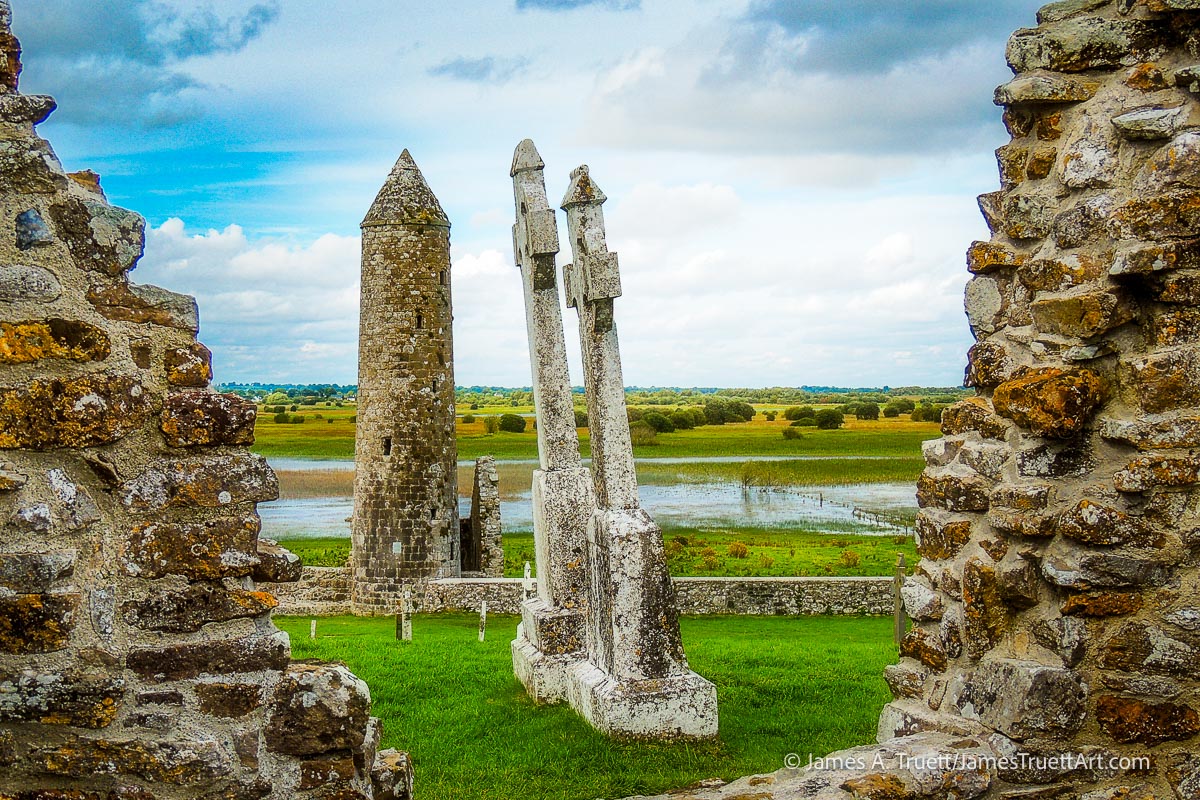
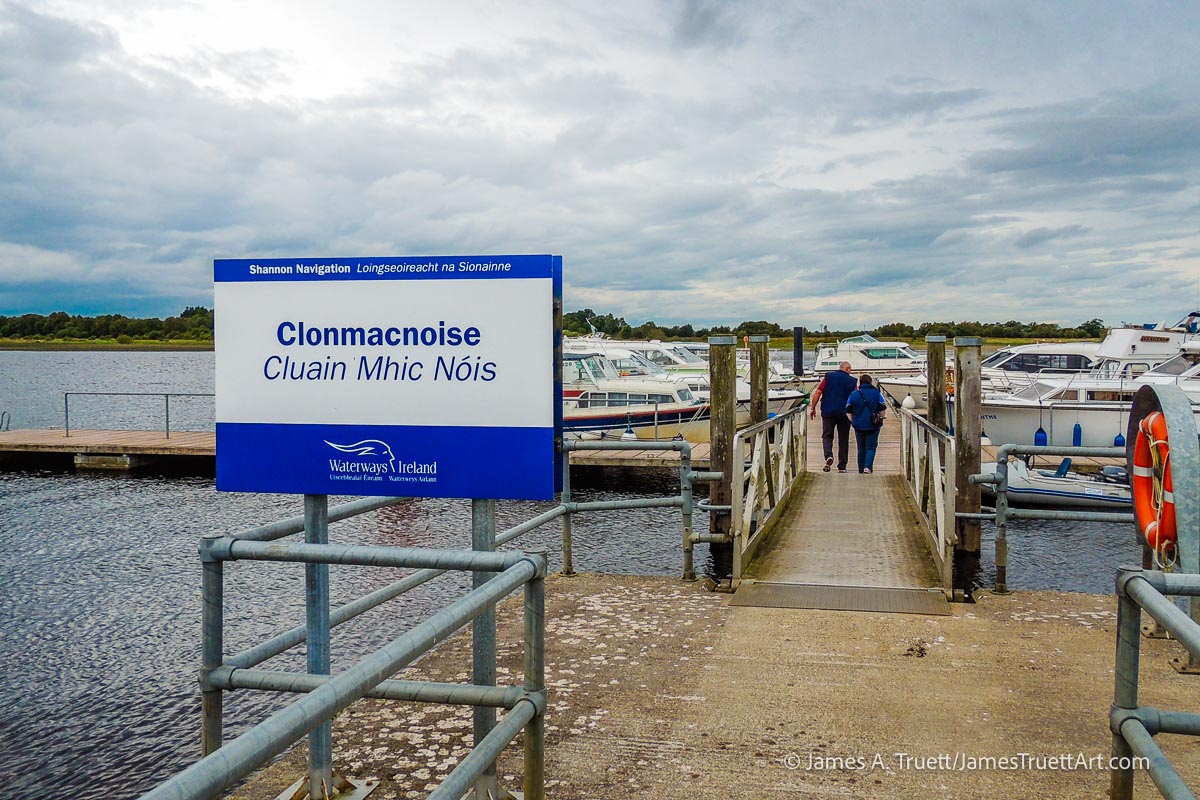
My cousins and I approached it aboard a chartered boat on the River Shannon. We had travelled out of Lough Ree, passed through the locks at Athlone and continued south until the ruins appeared along the eastern bank of the river.
After wanting to visit Clonmacnoise for years, arriving by water felt especially appropriate; long before roads carried visitors across County Offaly, the Shannon was one of the great routes into this remarkable settlement.
A Meeting Place Beside the Shannon
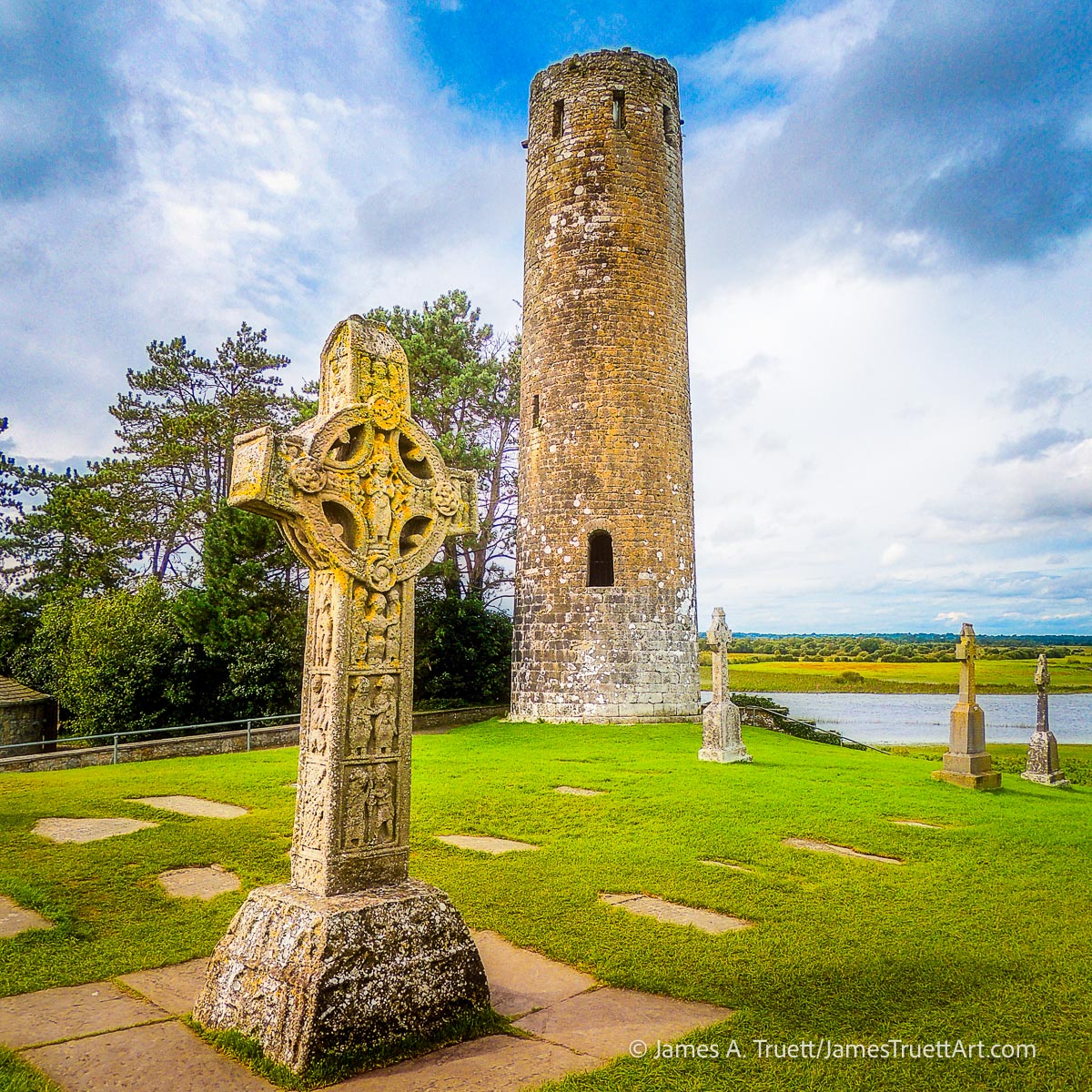
Clonmacnoise stands where geography and history came together.
Saint Ciarán founded the monastery here in 544 with a small group of companions. The site lay beside the Shannon at the point where an important east–west land route crossed the river. That position helped a modest religious community develop into a celebrated centre of worship, scholarship, craftsmanship and trade.
By the ninth century, Clonmacnoise was attracting scholars and skilled craftspeople from far beyond the Irish Midlands. Kings were buried here. Manuscripts were written here. Stone carvers and metalworkers produced objects of extraordinary refinement.
It is easy to look at the surviving ruins and imagine that Clonmacnoise was always a quiet, contemplative place. At its height, however, this must have been a lively community filled with voices, workshops, dwellings and people arriving from different parts of Ireland and Europe.
The river flowing beside it was not simply part of the scenery. It was one of the reasons Clonmacnoise flourished.
Four Centuries in a Single View
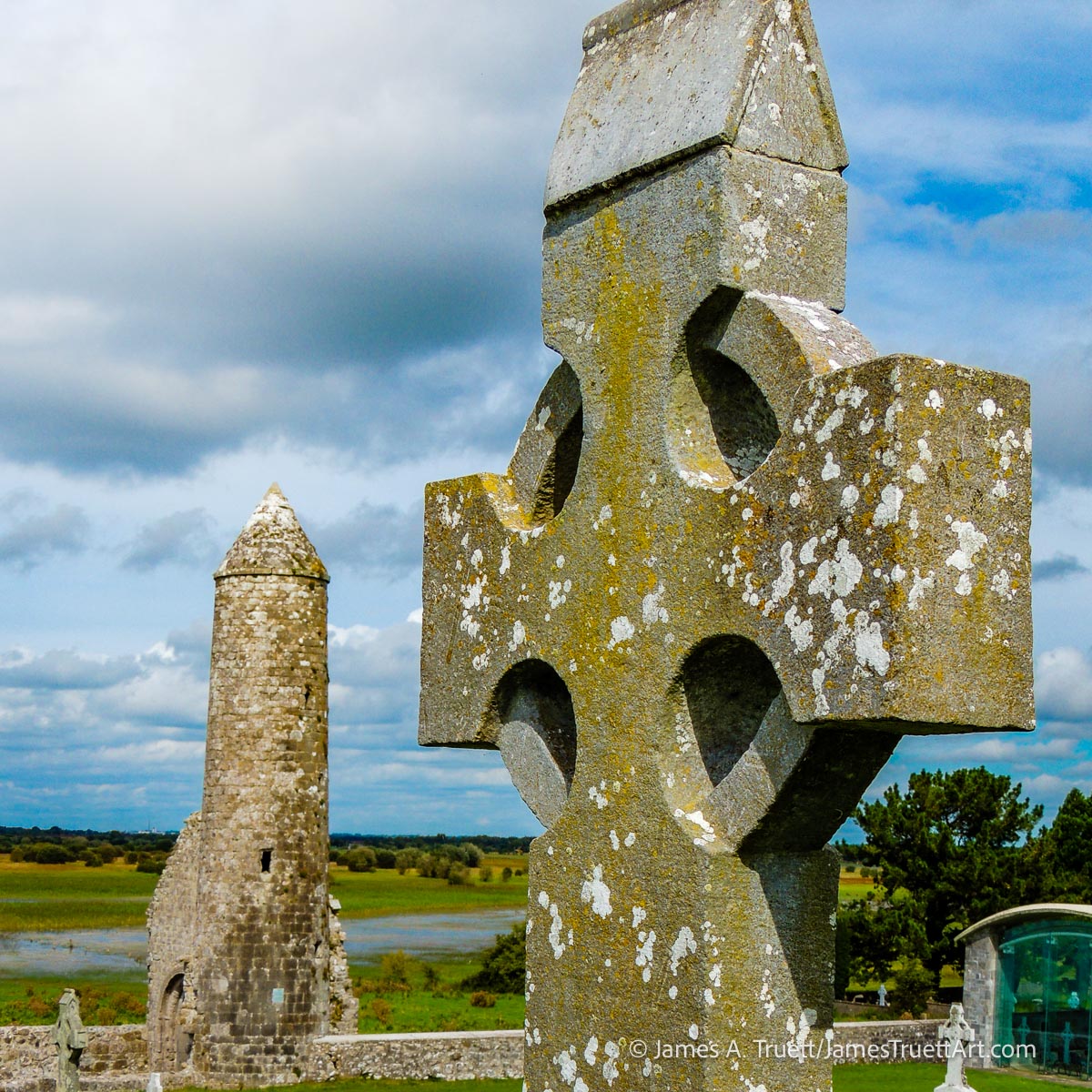
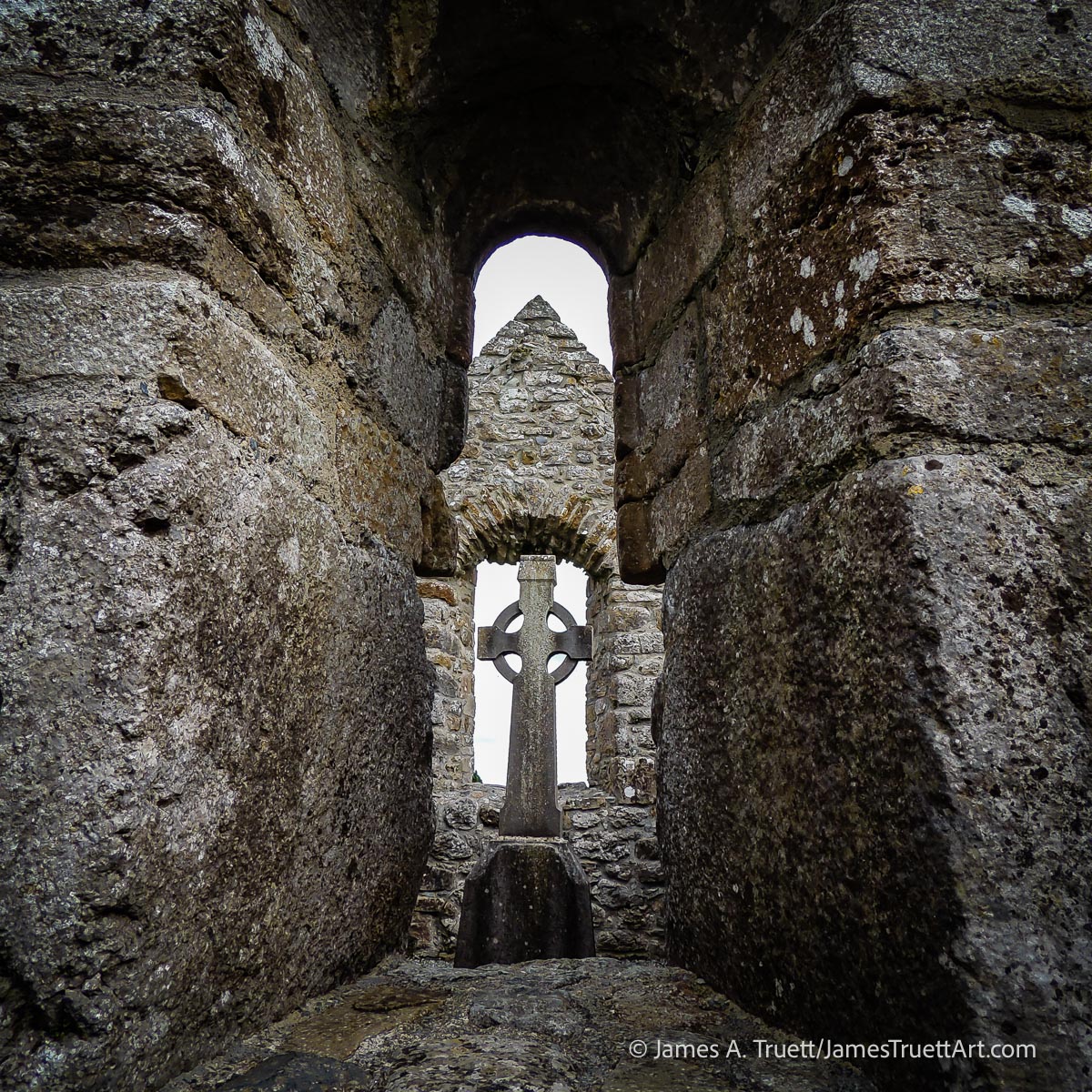
One of the most compelling views at Clonmacnoise is found through the ruins of the cathedral. Beyond its weathered stonework stand Temple Finghin and the slender form of McCarthy’s Tower, with the Shannon continuing behind them.
Several centuries of Irish history occupy that one frame.
Construction of the cathedral began around 909 under King Flann Sinna and Abbot Colmán. Nearly three hundred years later, in 1198, Rory O’Connor—the last High King of Ireland—was buried near its altar.
Temple Finghin and McCarthy’s Tower belong to the twelfth century. The church and round tower form an unusual joined structure, quite different from the freestanding towers more commonly associated with Irish monastic sites.
Even the later treatment of the ruins forms part of their story. Temple Finghin was vandalised during a pleasure outing in 1864. The Royal Society of Antiquaries of Ireland pressed successfully for the offender to be prosecuted, creating an important early example of the law being used to defend an ancient Irish monument.
That episode stayed with me. It shows that preserving history requires more than admiration. At some point, people must decide that what remains is worth protecting.
Stones That Once Spoke to Everyone
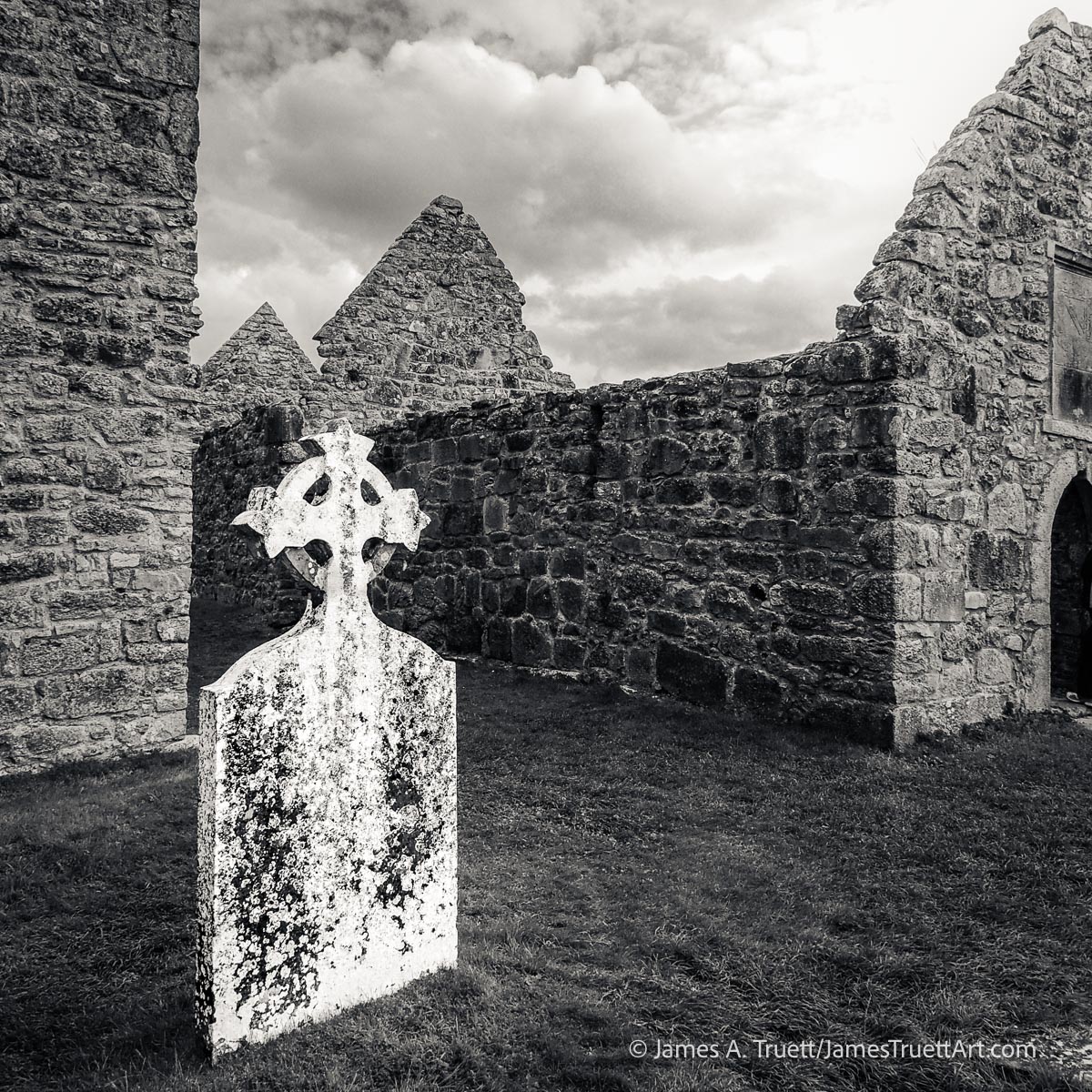
The high crosses of Clonmacnoise offer another glimpse into the artistry of the settlement.
The Cross of the Scriptures, created around the year 900, is divided into carved panels depicting biblical scenes. It was more than decoration. In an age when many people could not read, its images communicated stories, beliefs and ideas through stone.
The original cross is now protected inside the visitor centre, while a replica stands in its historic position outdoors. The arrangement allows visitors to appreciate both the detail of the carving and the place the monument held within the wider settlement.
Walking among the churches, crosses and grave slabs, I became increasingly aware that these were never isolated objects. They belonged to a community. Each had a purpose and a relationship to the people who gathered here.
Even now, separated from their original world by centuries, the stones retain something of that human connection.
Understanding the View from the River
I had seen photographs and videos of Clonmacnoise before visiting. I knew its history was extensive, and I expected the architecture to be impressive. What I had not fully appreciated was how much the river explained.
As our boat approached the landing, the location began to make sense in a way that it had not on a map. The Shannon was the path by which people, materials, news and ideas could reach this place. We were arriving by the same natural route that had helped sustain Clonmacnoise through its most influential centuries.
That was the moment the site changed for me.
The ruins were no longer simply the remains of churches constructed at different times. They became evidence of a connected and energetic settlement—one that had stood at a meeting point between water and land, devotion and commerce, scholarship and craftsmanship.
History runs deep at Clonmacnoise, but it does not feel distant. It is present in the worn stone, in the spaces between the buildings and in the steady movement of the Shannon beside them.
What Remains
Clonmacnoise endured repeated attacks, shifting political alliances, and the gradual shift of trade towards Athlone. Its influence declined, and the settlement was finally looted and destroyed in the sixteenth century.
Yet much remains: the cathedral, smaller churches, round towers, carved crosses and grave slabs marked with intricate patterns. Together, they allow us to see not a single moment, but the accumulated work of generations.
Perhaps that is what makes Clonmacnoise so absorbing. Its beauty does not depend on completeness. A broken wall can frame the river. An empty doorway can direct the eye towards a distant tower. A weathered carving can preserve the touch and imagination of a craftsperson who lived more than a thousand years ago.
We arrived by boat and eventually returned to the Shannon, leaving the ruins behind us on the riverbank. But the view remained with me: ancient stone surrounding an open stretch of water, and centuries of Irish life gathered quietly within a single frame.