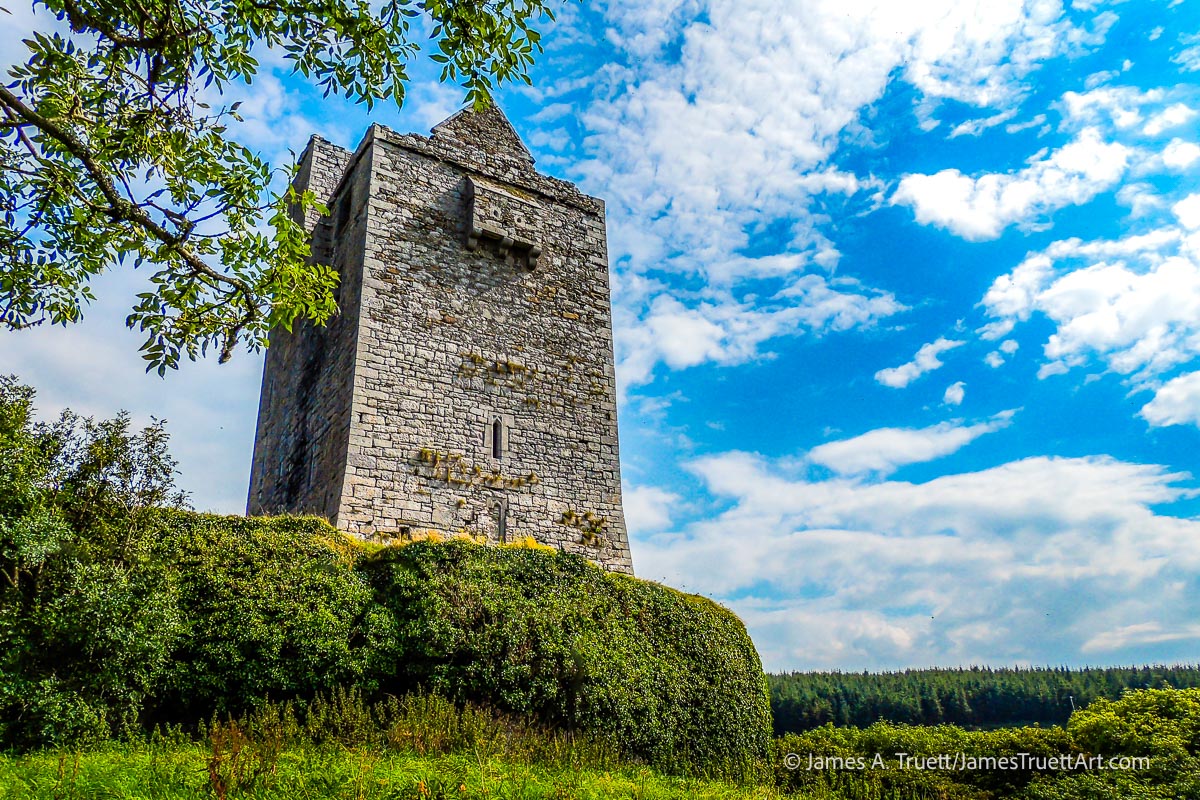
Ballinalacken Castle and the Long View Across Galway Bay
There are castles that seem to belong to the landscape, and others that appear to command it. Ballinalacken Castle does both.
Standing on its limestone outcrop between Doolin and Lisdoonvarna, the castle rises naturally from the stony edge of the Burren. Yet there is nothing accidental about its position. From that height, the land opens westward towards Galway Bay, the Aran Islands and the Atlantic beyond.
Whenever I visit, it is easy to imagine the people who lived there centuries ago keeping watch across that immense stretch of sea and sky. Their reasons for studying the horizon would have been very different from mine. They would have watched for approaching travellers, changes in the weather, friendly arrivals and possible danger.
I look for shifting light, the shape of the land and the way the castle holds its place against the western sky. The viewpoint is the same. Only the purpose has changed.

A Castle Shaped by Its Position
Ballinalacken is not set on a gentle green hill of the sort we often associate with romantic images of Ireland. It stands on exposed limestone, close to the western edge of the Burren, where rock frequently seems as important as soil.
The castle overlooks the routes towards Doolin, Fanore and Lisdoonvarna. Its Irish name is usually given as Baile na leachan, which may be translated as the town of the flagstones or stones. Looking at the surrounding terrain, the name feels entirely appropriate.
The builders clearly had defence in mind. One side of the site falls away sharply, while the height of the outcrop gives a wide view over the countryside and coast. Long before modern roads crossed below it, this would have been an excellent place from which to observe movement through the district.
That strategic advantage remains one of the castle’s most impressive qualities. Even in ruin, it controls the eye. You notice the tower before almost anything else around it.

A History Built in Stages
The precise beginnings of Ballinalacken are difficult to establish.
An earlier O’Connor fortification is traditionally associated with the site, and one account places a fortress here in the late 14th century. No visible remains of that earlier structure have been identified, however. The tower house standing today is generally dated to the 15th or early 16th century.
The building itself reveals that it developed over time. It consists of two connected sections, with the narrower eastern tower believed to be the older portion. The castle was surrounded by a defensive courtyard, or bawn, entered through a fortified gateway.
Inside were the practical elements of a working stronghold: a porter’s lodge, circular stairs, small windows, chambers on several levels and access to a wall walk. A Tudor-style chimney dated 1641 and openings designed for firearms show that the castle continued to change as defensive needs and domestic expectations evolved.
The O’Connors lost control of the surrounding territory during the 16th century, and Ballinalacken passed to the O’Briens. In the unsettled years following the 1641 rebellion, the castle escaped the destruction ordered for a number of other Clare fortifications.
That survival is remarkable. Centuries of Atlantic weather have softened edges and opened portions of the structure to the sky, but its essential form remains unmistakable.

Stone, Flowers and Atlantic Weather
One of my earlier photographs of Ballinalacken placed brilliant red hydrangeas against the grey castle walls. I have always enjoyed that contrast.
The flowers were temporary, vivid and full of life. Behind them stood stone that had already endured hundreds of winters. Neither diminished the other. The colour made the age of the castle more apparent, while the old walls gave the flowers a setting they could never have found in a carefully arranged garden.
That is something I often notice in the Irish landscape. Beauty rarely appears as one isolated object. It comes through relationships: red petals against weathered limestone, a dark tower beneath a bright opening in the clouds, or an old wall dividing one shade of green from another.
Ballinalacken offers those relationships in abundance. The weather arriving from the Atlantic can transform it within minutes. Strong sunlight reveals every irregular stone. Cloud can reduce the tower to a dark silhouette. Evening light warms the walls and briefly gives the ruin an almost inhabited presence.

Seeing the Castle from the Air
Flying my drone around Ballinalacken gave me another way of understanding the site.
From the ground, the castle’s height and mass dominate the view. From the air, its relationship with the wider landscape becomes clearer. The tower, outcrop, fields, roads and distant water begin to read as parts of a single composition.
The aerial view also explains the choice of location better than any written description. Galway Bay spreads beyond the West Clare countryside, with the Aran Islands resting along the horizon when visibility allows. The castle seems to face the entire western seaboard.
It must once have been a place of constant observation. Today, it invites observation from us.
Circling it from a respectful distance, I could see how tightly the structure is joined to the rock beneath it. The walls do not simply sit on the landscape; they appear to continue it upwards. Human hands shaped the tower, but the limestone determines its character.
Beside the ruins stands the country house built around 1840, now used as a hotel. Its continuing life creates another contrast: a roofed and inhabited house beside the open shell of the medieval stronghold. Together they show two very different chapters in the life of the same site.

The Watch Continues
Ballinalacken Castle has such an impressive presence because it is more than a surviving piece of architecture. It preserves a way of looking at West Clare.
Its inhabitants once watched the land and sea out of necessity. Standing there now, or seeing the castle from above, I find myself drawn towards the same horizon for quieter reasons.
The Aran Islands remain in the distance. Atlantic weather still travels across Galway Bay. Light moves over the Burren limestone, and the castle continues to keep its place above the roads.
After all these years, Ballinalacken is still watching the west—and still encouraging the rest of us to stop and look.