Ireland’s Forty Shades of Green: A Landscape in Technicolor
There is a moment in The Wizard of Oz when Dorothy opens the door, and the world changes from black and white to Technicolor. I wrote in the first book of my Mystical Moods of Ireland series that arriving in Ireland felt much the same to me.
The comparison has stayed with me because it is still the closest I can come to describing that first impression. Ireland does not simply appear green. It seems illuminated from within. Fields, hedgerows, moss, ivy and newly opened leaves each hold the light differently, and together they create a landscape with almost more colour than the eye can sort out at once.
People call them the forty shades of green. I have often thought there must be many more.

Along the Road to Lanna
One of my favourite places to watch those shades appear is along a country road in County Clare. It winds through the countryside between Lissycasey and Ballynacally toward the townland of Lanna, where my great-grandparents had their farm.
It is not a grand road. Like many rural Irish roads, it can narrow between hedges and stone walls, turn without much warning and lead into places whose names may not appear on every map. That is part of its character. It asks you to slow down.
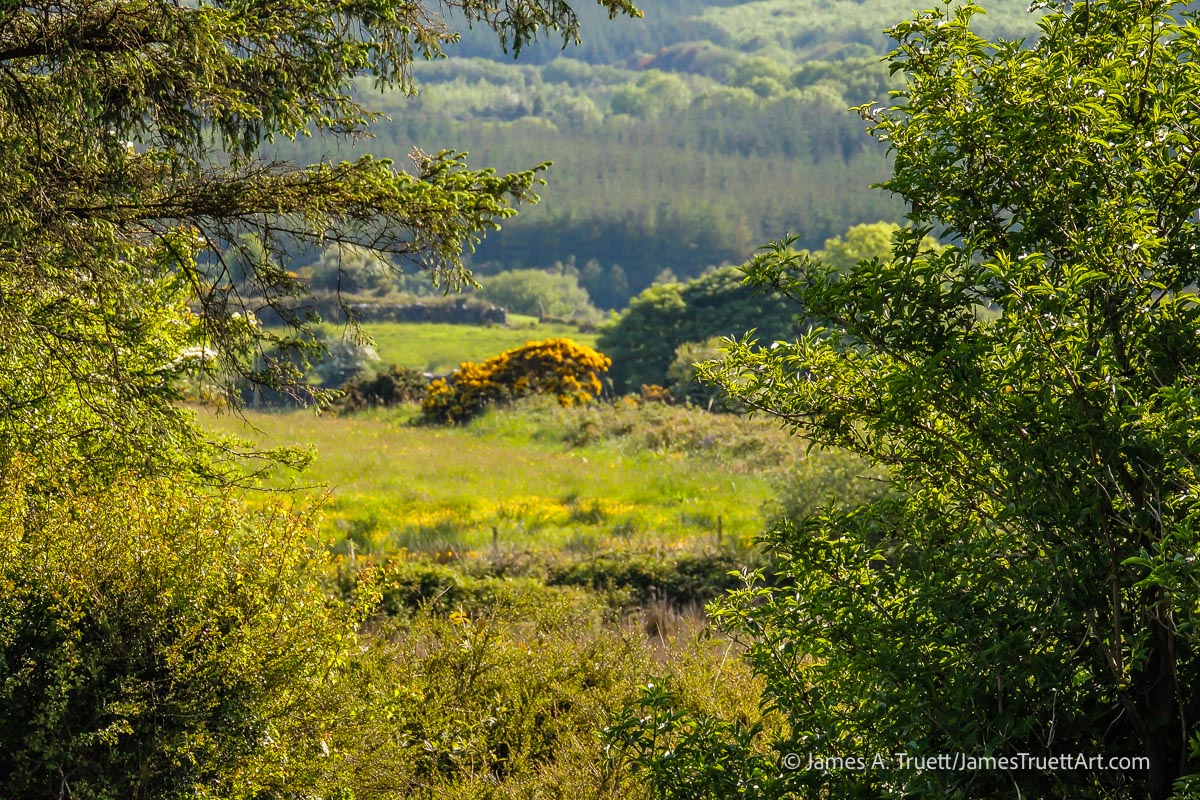
In spring, the road can feel like a green corridor. Fresh leaves brighten the hedgerows. Fields rise and fall beyond them in irregular pieces, divided by walls, fences and old boundaries. A darker stand of trees might form the background while sunlight passes across a pasture in one brilliant streak.
Drive the same road an hour later, and it may look entirely different.
That changeability is part of what makes the Irish countryside so absorbing to me as an artist and photographer. The landscape is never merely sitting there. Clouds move in from the Atlantic, rain softens the distance, a sudden opening in the sky catches one hillside, and familiar ground becomes new again.

More Than a Number
The phrase “forty shades of green” became known around the world through Johnny Cash. He wrote his song after visiting Ireland in 1959, and it was first released in 1961. The words travel across the island, naming places from Dingle and the River Shannon to Skibbereen, Tipperary, Cork and Larne.
Perhaps that is why the song has lasted. It is not only about colour. It is about memory and longing—the way a landscape remains vivid after you have left it.
That feeling is familiar to many people who have visited Ireland. Leaving can be surprisingly difficult. Long after the journey is over, a small detail returns: rain shining on a boreen, ivy wrapped around a tree trunk, the dark line of a hedgerow, or a meadow suddenly lit beneath a stormy sky.
The number forty need not be taken literally. It gives a name to the variety we notice when we truly begin to look.
There is the yellow-green of new growth and the deep green of wet ivy. There are blue-green shadows under trees, the muted olive of rushes and the startling brightness of a field when sunlight breaks through. Even under ominous skies, the countryside keeps revealing new greens. Sometimes the darkest clouds provide the contrast that makes a pasture seem to glow.

What the Rain Leaves Behind
Ireland’s colour is inseparable from its Atlantic climate. The ocean moderates the temperatures, while frequent rain—especially in the west—feeds the fields, woodlands and hedgerows. In County Clare, a soft shower may pass and leave every leaf polished. The rain deepens the landscape for a while, and then the returning light lifts certain greens forward while others recede.
Rain is only part of the story. Ireland has a comparatively small native flora for a European country, partly because ice sheets covered much of the island until about 13,000 years ago. Yet within that smaller palette, the combinations are wonderfully rich. Plant communities change from meadow to bog, limestone pavement to woodland, roadside verge to Atlantic cliff.
And the green is rarely alone.
Spring brings daffodils and new leaves. Later, buttercups, Ragged Robin, foxgloves and wild roses scatter colour through the fields and hedges. Montbretia adds a stroke of orange along summer roadsides. Great Willowherb rises beside stone walls and boreens, its pink blossoms sometimes still holding drops after a storm.
These accents make the surrounding greens easier to see. A pink flower, an orange bloom or a white cottage does not interrupt the landscape; it reveals another layer of it.

Learning to See the Light
Photography has taught me that green can be surprisingly elusive. A camera may record a broad area as one colour, while the eye sees the subtle differences created by moisture, distance, texture and light. The task is not to make the countryside greener than it is. It is to notice what is already there.
Some of my most memorable scenes have appeared on ordinary journeys rather than planned excursions. On the way home from a family lunch, I once came across a County Clare meadow dotted with wildflowers beneath perfect layers of light. On another day, newly sprouted leaves caught my attention through a window while I was washing dishes. Beauty has very little respect for schedules.
This landscape became part of my Mystical Moods of Ireland books, including Enchanted Celtic Skies, Enchanted Celtic Skies II and Magical Irish Countryside. The photographs grew from a habit of watching how the same fields, roads and skies changed from one season—or one minute—to the next.
The Colour That Stays With You
Ireland still gives me that sensation of stepping into Technicolour. Familiarity has not diminished it. If anything, living here has shown me that the first burst of green was only an introduction.
The real discovery is in the differences: a patchwork of fields near Frure, rain-darkened hedges outside Lissycasey, brilliant pasture beneath boiling clouds, or wildflowers brightening the road home. Each is a reminder that a place need not be new to astonish us. We may simply need to look again.
Perhaps that is why Ireland can be so hard to leave. Its colour follows you—not as a single postcard image, but as a living landscape of rain, light and memory. Forty shades are only the beginning.