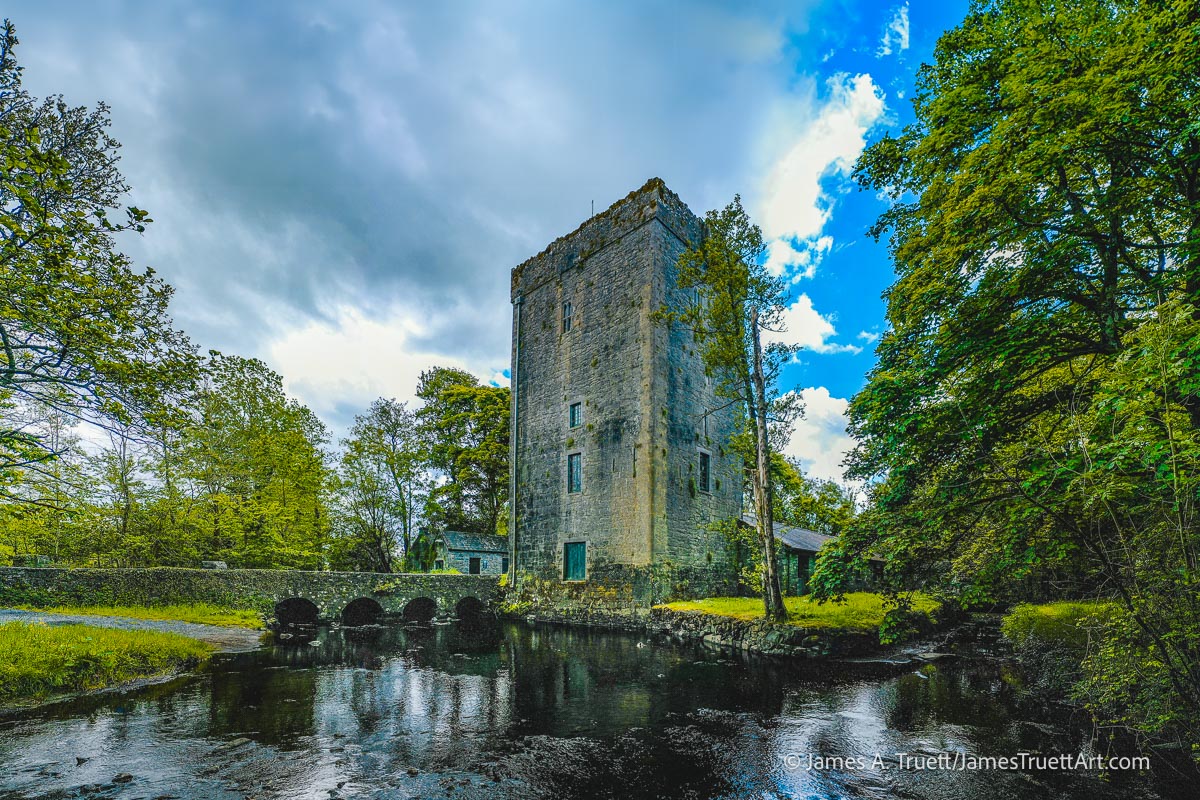
Thoor Ballylee: Inside W. B. Yeats’s Tower and the Faerie Forest Beyond
Some places keep history safely enclosed in glass cases, carefully labelled and held at a distance. Thoor Ballylee is not one of them.
Here, beside the Streamstown River near Gort in County Galway, the past feels close enough to touch. It waits in the worn stone stair, in the narrow windows and shadowed rooms, and in the water moving beneath moss-covered trees outside.

I was thrilled to be allowed inside for my first special visit in 2015, arranged by Sister de Lourdes Fahy, with Brendan Farrell opening the tower for me. The Yeats Thoor Ballylee Society was preparing to welcome summer visitors again, and I had the rare opportunity to explore the building before its reopening.
I had admired the tower from outside, but crossing its threshold changed my understanding of it. This was no distant literary monument. It was a home, a refuge, and a place where architecture, landscape, history, and imagination became inseparable.

A Tower Reclaimed by a Poet
The stone tower at Ballylee dates to around 1450. Built in the tower-house tradition associated with the de Burgo, or Burke, family, it contains four principal rooms stacked one above another and connected by a winding stone stair.
W. B. Yeats purchased the neglected property in 1916 for £35. Working with architect William A. Scott and local builder Michael Rafferty, he restored the tower, adjoining cottage, and outbuildings with a careful use of local materials.
In 1918, Yeats renamed it Thoor Ballylee, taking “Thoor” from the Irish word túr, meaning tower. From 1921 until 1929, he and his family spent many summers here.

The tower became far more than a summer residence. It offered Yeats a rooted place in the west of Ireland, close to Lady Gregory’s Coole Park, where he had already found friendship, creative discipline, and a landscape filled with literary possibility.
Many important poems were written here or shaped by the tower and its surroundings. Its presence runs through “The Tower,” “A Prayer for My Daughter,” “Meditations in Time of Civil War,” and “Coole Park and Ballylee, 1931.” Even the titles of his collections The Tower and The Winding Stair and Other Poems reveal how deeply the building entered his imagination.

Climbing the Winding Stair
Moving upward through Thoor Ballylee means following the stair that became one of Yeats’s most enduring symbols.
The steps curve through the thickness of the stone wall, carrying visitors from the first-floor dining room to the living room, bedroom, Stranger’s Room, and finally the rooftop battlements. With each turn, the modern world seems to recede.
Large windows on the lower floors open toward the riverside greenery. They soften the defensive character of the tower and remind us that this austere structure was made into a family home. George Yeats did much to make it habitable, even decorating the sitting room with constellations and esoteric designs.

Higher up, the atmosphere changes.
The uppermost chamber, traditionally known as the Stranger’s Room, retains narrow arched windows, rough-hewn stone walls, and an immense fireplace. It feels older and less domesticated than the rooms below. Standing there, I was awestruck by the history whispering from the ancient walls.

Stories of hauntings have long gathered around the tower. Yeats himself was deeply interested in folklore, spiritualism, mythology, and unseen worlds, so it's almost inevitable that ghost stories became part of Ballylee’s atmosphere.
I will not claim that I encountered a ghost. Still, the Stranger’s Room had an eerie, otherworldly presence that left me wondering about everyone who had passed through it during the previous six centuries.
From there, I squeezed through the narrow rooftop doorway and stepped onto the battlements. The panoramic view across the County Galway countryside made every awkward step worthwhile. The landscape opened in every direction, revealing why the tower could serve both as a physical lookout and as a place from which imagination might travel.

Into the Faerie Forest
Outside the tower, a path follows the Streamstown River toward the old mill. Its established name is the River Walk, but I have always called the woodland around it the Faerie Forest.
In spring and summer, sunlight filters through luminous leaves. Herb Robert, buttercups, Lesser Celandine, bluebells, and other wildflowers brighten the riverbank. Water murmurs past contortionist trees and moss-covered limbs while birds sing a choral welcome from the canopy.
It is one of my special Happy Places. There is great peace here.
The river also holds a more mysterious face. While photographing Herb Robert beside the water in June 2017, I concentrated on the flowers and reflections before me. Only later, when I examined the photographs at home, did I notice strange shapes that appeared almost to be looking back through the water.
Were they visitors from some imagined faerie realm—or simply pareidolia, the mind discovering faces in random patterns? I still do not know. That uncertainty is part of the pleasure. Ballylee invites imagination without demanding that mystery be explained.

Following Yeats Through Coole Park and Ballylee
My connection with this landscape eventually became a book, Mystical Moods of Ireland, Vol. IV: In the Footsteps of W. B. Yeats at Coole Park and Ballylee. Published in 2015, the 134-page photographic journey follows the paths, woodlands, waterways, and historic rooms that helped shape Yeats’s imagination.
Creating the book allowed me to explore the relationship between the poet and these two remarkable County Galway places. I wandered through the Seven Woods, sat beside Coole Lough, followed the Streamstown River, climbed the winding stair, and looked across the countryside from the battlements of Thoor Ballylee.
The experience deepened my understanding of how profoundly a landscape can influence creative work. Yeats translated the spirit of Ballylee into poetry. I sought to express something of that same atmosphere through photographs—preserving its changing light, textures, colours, and mysterious moods for readers who may never have the opportunity to walk these paths themselves.

From Riverbank to Artwork
My years exploring this landscape eventually led to Streamstown River Reflections, an artwork inspired by the luminous stillness of the river as it passes through the Faerie Forest beside the tower.
The image has since travelled far beyond this quiet corner of County Galway. It appeared during Miami Art Week in December 2025, illuminated a large screen in New York’s Times Square in February 2026, and continued to exhibitions in Strasbourg and Palma de Mallorca.
Another river-inspired work, Shimmering Irish Autumn, grew from the flamboyant textures and colours reflected here later in the year. Yet no matter how far these images travel, their origin remains the same: light meeting water beneath the trees at Ballylee.

A Living Place
Thoor Ballylee has repeatedly been threatened by neglect, damp, and serious flooding. First restored as a Yeats museum in 1965, it suffered extensive damage in winter 2009. The voluntary Yeats Thoor Ballylee Society helped bring it back to life, reopening the tower in June 2015 and continuing to care for it as a cultural and literary destination.
That work matters because Thoor Ballylee is not merely a building associated with a famous poet. It is part of the living relationship between art and place.
Inside the tower, Yeats transformed stone, stair, river, and memory into poetry. Outside, generations of visitors continue to find their own meanings in the moving water and changing woodland light.
Whenever I return, I understand his attachment a little more clearly. Ballylee does not surrender all its mysteries. It asks us to slow down, look carefully, and leave space for the unseen.
Sometimes that is precisely where art begins.
Explore the artwork Streamstown River Reflections, or continue the journey through my book, In the Footsteps of W. B. Yeats at Coole Park and Ballylee.