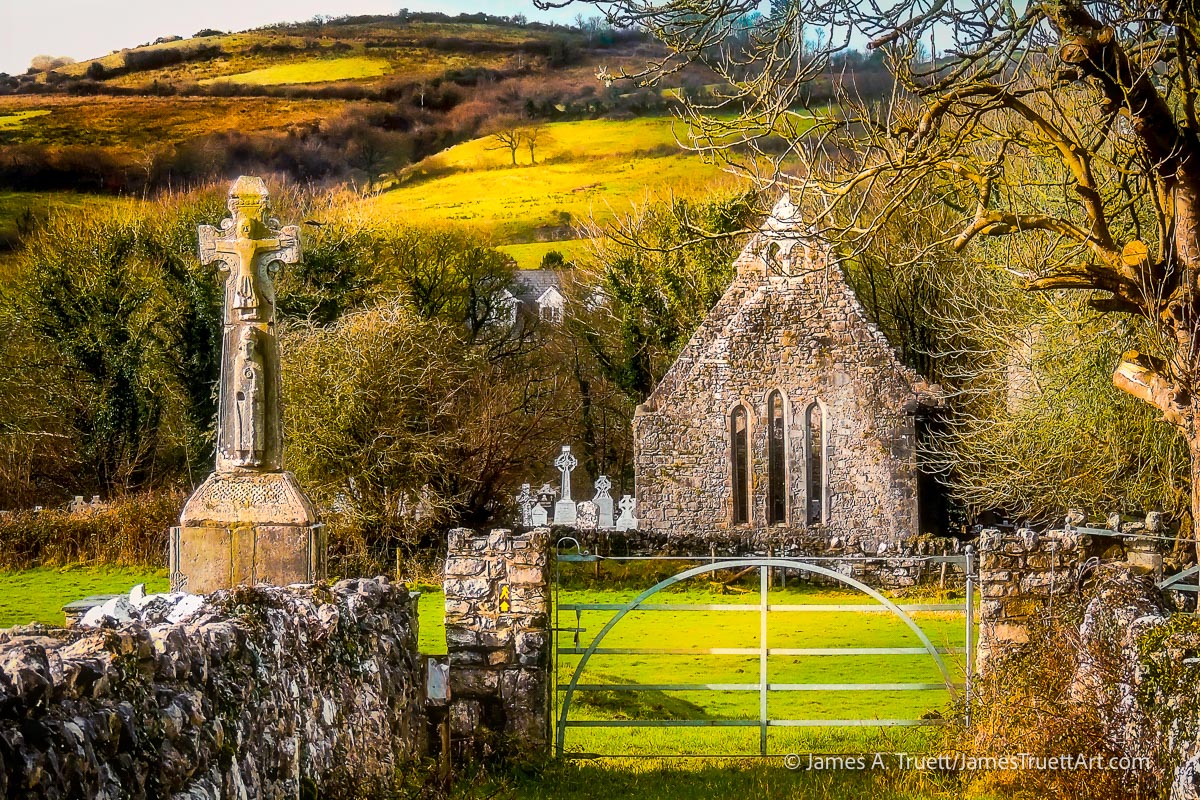
St. Tola’s Cross at Dysert O’Dea, County Clare
Standing in the middle of a cow pasture, dodging piles of cow manure, it is a little puzzling to find myself face to face with the 12th century.
There is no grand avenue leading to St. Tola’s Cross at Dysert O’Dea. The cross stands in a field in the County Clare countryside near Corofin, its weather-worn stone surrounded by grass, cattle and the ordinary business of a working farm.
That incongruity is part of what makes the place so memorable. One moment I am watching where I put my boots. The next, I am studying a figure carved by a medieval mason perhaps eight and a half centuries ago.
Across the field are the ruins of Dysert O’Dea Church, its elaborate Romanesque doorway, the remains of a round tower and a graveyard still in use. Farther off, the restored Dysert O’Dea Castle rises above the countryside. Within a relatively small area, the landscape moves through centuries almost casually.

From St. Tola’s hermitage to Dysert O’Dea
The church stands on the site of an early Christian settlement traditionally associated with St. Tola, an eighth-century churchman who later became Bishop of Clonard. He died sometime between 733 and 737.
The place was once known as Diseart Tola—Tola’s hermitage—and later became Dysert O’Dea through its association with the O’Dea family. Most of the visible medieval remains, including the church sculpture and high cross, date from the 12th century.
It is tempting to think of the site as belonging to a single period, but Dysert O’Dea resists such simplicity. It began as an early Christian settlement, developed into a richly ornamented medieval church site, was repaired and rearranged over subsequent centuries, and remains part of a living rural and burial landscape.
The cross itself stands in the field east of the church. With its later base, it reaches approximately twelve feet in height. It is tall enough to command attention but not so monumental that it loses its human scale.

Reading the carvings
On the east face, Christ appears on the cross above the large figure of a bishop or ecclesiastic. The lower figure is often identified as St. Tola, although that interpretation is not certain. Heritage sources note that another saint has also been proposed.
Around these figures are geometrical patterns, human forms and animals woven into interlacing designs. Time has softened their edges, but the surviving sculpture still rewards a slow look.
The missing arm of the ecclesiastical figure is one of the cross’s most intriguing details. Scholars have suggested that its socket may once have held a removable metal reliquary. It is an evocative possibility rather than a settled fact—one more reminder that the monument cannot tell us everything it has witnessed.
The carving also creates a visual connection with the nearby church. Specialists have identified striking similarities between the animal interlace, foliage and human faces on the cross and those in the Romanesque sculpture. The resemblance is strong enough to suggest that the cross, doorway and window may have come from the same workshop.
That thought changes the way I see the site. The cross is not an isolated object placed in a convenient field. It belongs to a larger artistic composition spread across the landscape.

A monument with more than one lifetime
The cross that survives today is not an untouched relic.
By the 17th century, the church had fallen into disrepair. An inscription records that Michael O’Dea repaired the cross in 1683, when it was erected on a pedestal incorporating stones from the church. It was recorded as broken again in 1839 and re-erected in 1871. Other repairs followed.
Its restored condition does not diminish it. If anything, those interventions form part of its biography. Generations considered the cross important enough to lift, mend and preserve.
Standing beside it, I was looking not only at the work of a medieval sculptor but also at evidence of the people who refused to let that work disappear.

Faces in the Romanesque doorway
The church presents another exercise in careful looking.
Its south doorway is one of the best-known Romanesque features at Dysert O’Dea. The outer arch carries nineteen carved human and animal heads. Other stones display chevrons, foliage, fantastic creatures and forms influenced by both Irish traditions and the wider Romanesque world.
The doorway is not preserved exactly as its original builders arranged it. Archaeological scholarship indicates that it was reconstructed from medieval fragments and may combine material from more than one doorway or window.
Even in its altered form, it has remarkable presence. The carved heads look outward from the arch as though an entire medieval gathering has been fixed in stone.
Nearby, the partial round tower adds another silhouette to the scene. It was later adapted as a defensive structure, while the churchyard continued to receive burials. Ruin, repair and continuing use are all present at once.

Portals through time and space
I have returned to this area more than once, and I still have not scratched the surface of what it contains.
The high cross and Romanesque doorway also followed me home through my photographs. In one composite artwork, Romanesque Doorway and High Cross at Dysert O’Dea, I framed the cross through the church portal, bringing two elements of the site into a single view. The image later appeared in my book Portals through Time: Irish Doorways & Windows.
Sometimes individual photographs seem too ordinary on their own. I enjoy taking pieces of them and creating what I once described as portals through time and space. At Dysert O’Dea, that idea hardly needs invention. The place already behaves like a portal.
Yet my clearest memory remains wonderfully unromantic: the cattle pasture, the manure underfoot and the strange feeling of encountering such accomplished medieval sculpture in the middle of it all.
Perhaps that is why the cross belongs here. History in Ireland is not always placed at a distance behind glass. Sometimes it stands in a meadow, sharing the weather with grazing cattle while a ruined church, a broken tower and a restored castle hold their places on the horizon.
You watch where you step, look up—and find eight centuries waiting for you.