Inside Dysert O’Dea Castle: A Tower House Restored
Some castles reveal themselves gradually. Dysert O’Dea does not.
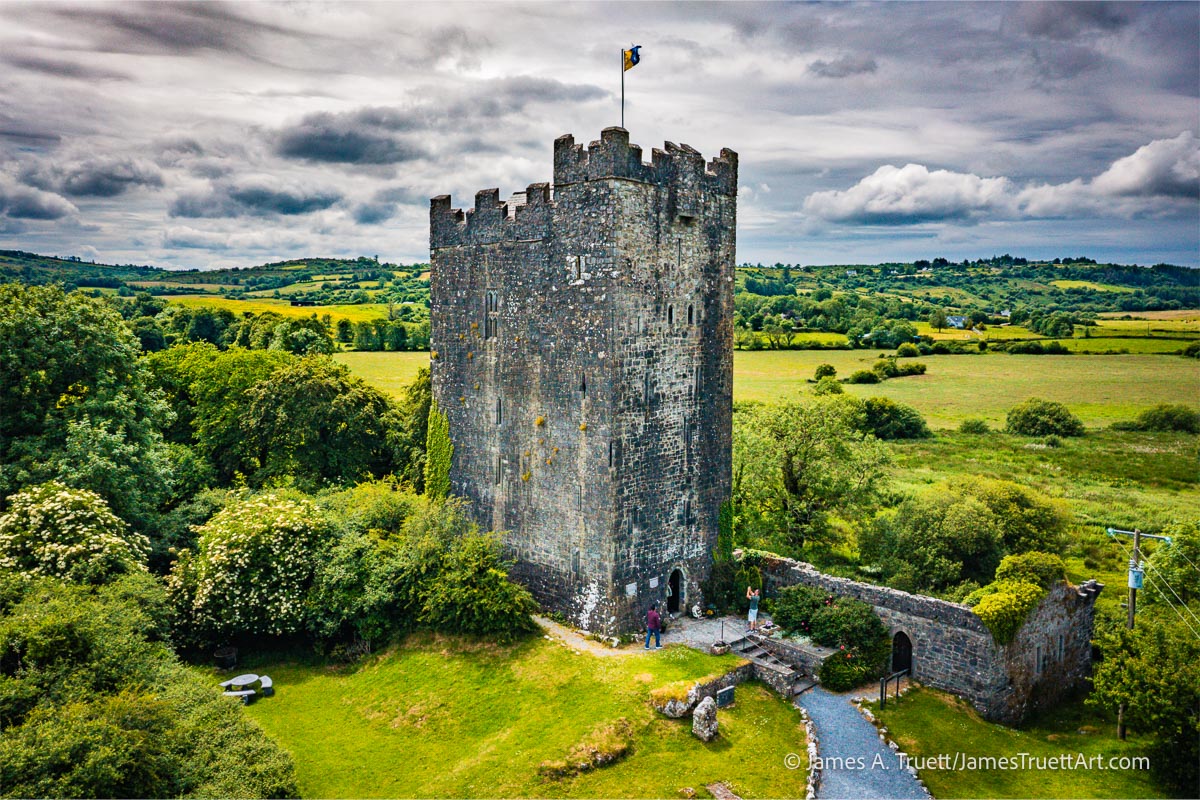
As you approach through the County Clare countryside near Corofin, the tower house rises almost abruptly above the trees and stone walls. Its narrow windows and high battlements give it a stern, vertical presence. Even after many visits to castles across Ireland, I still find the first sight of it exhilarating.
Dysert O’Dea is one of my absolute favourites. Part of that affection comes from the building itself, but much of it comes from what happens when you step through the doorway. This is not simply a medieval shell preserved against the weather. Its rooms have been restored and opened in a way that offers a remarkably convincing glimpse into the life of an Irish tower house.

Inside the Stone Walls
The castle contains ten rooms arranged across four floors. Moving upward through them gives you an immediate sense of how differently life was organised when security mattered as much as comfort.
The walls are thick, the window openings narrow and the rooms stacked one above another. Yet the interior is not uniformly dark. Light enters through deep-set windows and falls across the stone floors, fireplaces and furnished rooms in bright, concentrated shapes.
One of my favourite interior views is the dining room, where daylight streams through the window towards the table. Elsewhere, exhibits and displays explain the history of the castle and the work involved in bringing it back from ruin.
That attention to restoration is what makes Dysert O’Dea so rewarding. You can examine the masonry and defensive features, but you can also begin to imagine the ordinary rhythms of the place: meals prepared near the fire, conversations around a table, people climbing between floors, and someone pausing at a window to watch the surrounding countryside.
It does not feel like an empty monument. It feels legible.

A Gaelic Tower House
Although we casually call it a castle, Dysert O’Dea is more precisely a fortified Gaelic tower house. It was built between 1470 and 1490 by Diarmaid O’Dea, Lord of Cineál Fearmaic, and is traditionally dated to about 1480.
The distinction matters. Tower houses were not sprawling royal palaces. They were tall, compact residences built to combine family life, local authority and defence. Dysert O’Dea’s small openings, strong masonry and vertical arrangement all belong to that practical world.
Its history was far from peaceful. The Earl of Ormond’s forces took the stronghold from the O’Deas in 1570, but records show it back in O’Dea possession by 1584. The following century brought further upheaval. Cromwellian troops occupied the castle in 1651, and its upper floors, battlements and staircase were badly damaged.
The tower survived, but gradually became a ruin. That makes the rooms we can enter today all the more remarkable.

A Family Restoration
The modern story began when John B. O’Day of Wisconsin encountered the ruined castle for sale in 1968. The O’Day name is an Americanised form associated with O’Dea descendants, giving the discovery a strong ancestral connection.
After the family acquired the property, repairs carried out from 1971 to 1983 protected the surviving structure and restored the damaged upper portions. The Dysert O’Dea Castle Archaeology Centre opened in 1986.
That work did more than save four walls. It returned the building’s height, rooms and internal relationships to visitors. Instead of looking at a roofless ruin and trying to reconstruct it entirely in the imagination, we can climb through the tower and experience its scale from within.
In 2024, I had the pleasure of meeting John and Kris O’Day in Corofin while they were preparing the castle for another season. Encounters like that are a reminder that preservation is rarely an abstract process. It depends upon people willing to accept a long responsibility for a place.

A Landscape Older Than the Castle
Dysert O’Dea would be worth visiting for the tower house alone, but the surrounding landscape gives it an unusual depth.
The archaeological trails connect 25 sites and monuments scattered through the countryside. They include stone and earthen forts, holy wells, ancient cooking sites, medieval roads and later houses and schools. Near the castle stand the ruins of Dysert O’Dea Church, the remains of a round tower and a finely carved twelfth-century high cross.
The church occupies the site of an early Christian community associated with St Tola. Its Romanesque doorway, decorated with carved human and animal heads, chevrons and scalloped forms, is one of the most memorable details in the wider complex.
The land also carries the memory of the Battle of Dysert O’Dea, fought on 10 May 1318—more than a century before the present tower house was built. Richard de Clare was defeated and killed by Gaelic forces led by Conor O’Dea and his allies, decisively changing the balance of power in Thomond.
That breadth of history is why I never feel I have exhausted the place. One trail leads to another monument, another view and another period of Irish life.

The View from the Top
Eventually, the climb brings you to the upper wall walk. From there the defensive logic of the tower becomes obvious, but so does the beauty of its position.
The County Clare countryside spreads outward in luminous greens, divided by hedges and stone walls. Ballycullinan Lough lies in the middle distance, with Corofin beyond it. Looking down, the castle that seemed so imposing on approach becomes the centre of a much larger historical landscape.
That view completes the experience for me. You begin at ground level, confronted by the height and strength of a medieval tower. You pass through restored rooms that make its human scale visible. Then, from the top, the walls open onto centuries of history written across the surrounding fields.
Dysert O’Dea stands strong because someone chose to restore it. More importantly, it allows the past to feel close enough to enter, explore and see for yourself.
To explore more of County Clare’s castles through my photography, see Awesome Ireland No. 1 – Castles of County Clare.