
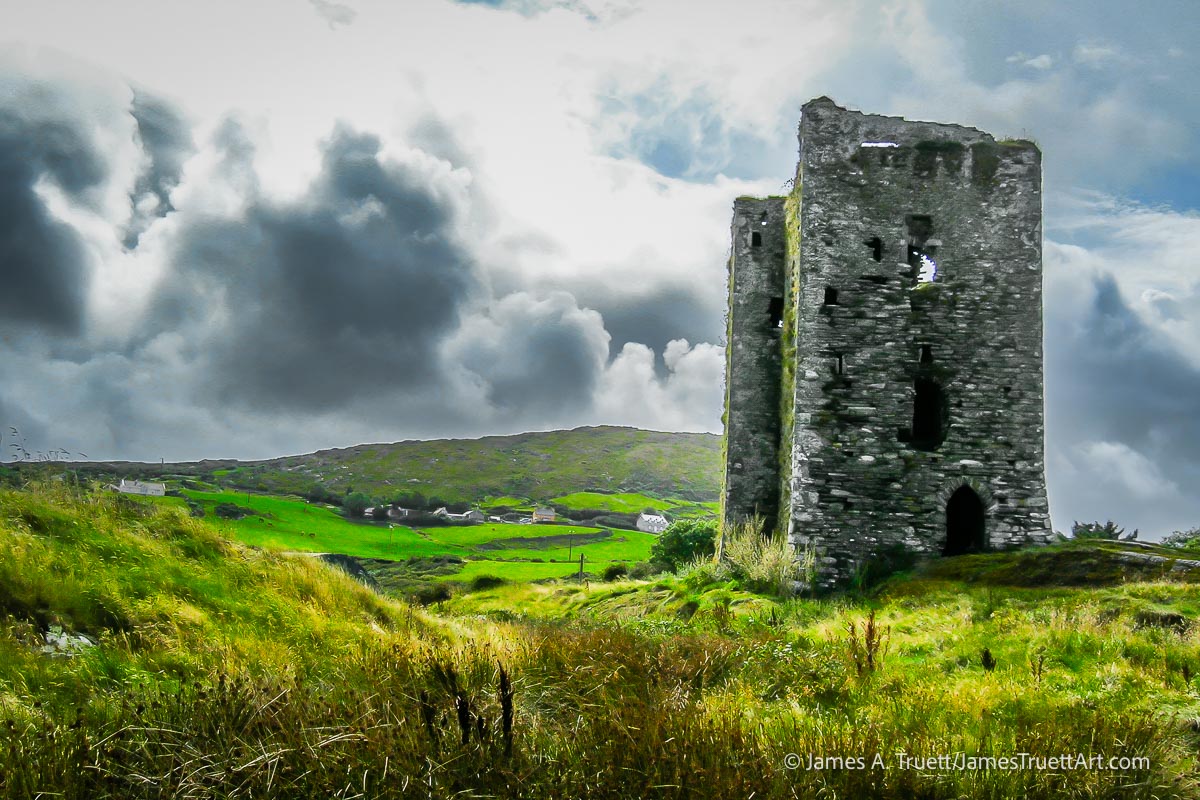
Dunmanus Castle: A Stone Giant on the Mizen Peninsula
I did not set out to find Dunmanus Castle. I stumbled upon it while exploring West Cork’s Mizen Peninsula during my first visit to Ireland in 2006.
That is still one of my favourite ways to meet a place. A narrow boreen carries you around a bend, the hedges shift, and suddenly something that has occupied the landscape for centuries is standing in front of you.
Dunmanus did not appear dainty or theatrical. It rose from its rocky outcrop like a stone monster, severe and weathered, towering above the little road. The wind coming off the bay only added to its presence.
Castles have always fascinated me. The simple fact that so many are still standing after hundreds of years seems remarkable. Yet the longer I looked at Dunmanus, the less it resembled the comfortable castle of our imagination.

Defence, Not Glamour
It is easy to romanticise castle life. We furnish the empty rooms in our minds, light a few grand fireplaces and quietly ignore the cold, the smoke, the darkness and the smell.
There was no electricity, no running water and certainly no deodorant waiting at the end of the boreen. Sanitation meant stone chutes rather than plumbing. The narrow openings at the lower levels admitted little light, and the thick walls that offered protection also held in the damp and chill.
Dunmanus was not a Norman castle, as Irish ruins are sometimes casually labelled. It was a Gaelic stronghold associated with the O’Mahony clan. More precisely, it was a tower house—a defended residence built for a powerful family in a landscape where home, authority and security were closely connected.
The distinction matters. Defence was essential, but this was not merely a bunker. It was also a household, a statement of status and a centre from which the surrounding land and waters could be watched.
A House Built into the Rock
Dunmanus Castle is traditionally dated to about 1430 and attributed to Donogh More O’Mahony. Its architecture is consistent with that early fifteenth-century date, although some accounts place its construction a little later.
The building consists of two attached towers, an arrangement found in several West Cork tower houses but much less often elsewhere in County Cork. Inside was a complex vertical world of mural-clad stairs, vaulted chambers, upper living rooms, and a dungeon-like space reached from above. A raised entrance offered greater security, while the more generous windows belonged to the upper rooms rather than the storage spaces below.
I could imagine how confusing those stairwells and chambers might have seemed in dim light. You would nearly need a map to find your way around—and that may have been part of the point. A stranger would not understand the building as its occupants did.
The castle’s strength began with its site. Rock falls steeply away on two sides, while a small sheltered harbour and a sloping shore offered a natural landing place for boats. From above, the O’Mahonys could observe movement across Dunmanus Harbour and the larger bay beyond.

The Wealth Beyond the Walls
Dunmanus Bay lies between the Mizen and Sheep’s Head peninsulas, opening westward toward the Atlantic. Today I respond first to its changing light, low hills and windswept coast. In the late medieval period, those waters were also a source of wealth.
Fishing was a major part of the economy along the south and southwest Cork coast. Fleets from continental Europe and England worked these waters, and Gaelic lords could profit by collecting customary dues and controlling sheltered anchorages. Dunmanus Castle’s position beside a harbour made sense economically as well as defensively.
That setting changes the way I see the ruin. The castle was not simply watching for an enemy. It was watching a working seascape—boats arriving, catches moving, people landing and news travelling along the coast.
The O’Mahony hold on the place did not last forever. Crown forces took Dunmanus in 1602, soon after the Battle of Kinsale, and the O’Mahonys recovered it. In 1643 the clan was outlawed and its lands, including the castle, were confiscated and granted to new English settlers.
The great stone house eventually became the roofless structure I encountered three and a half centuries later.
What the Ruin Keeps
I photographed Dunmanus because that is often how I begin to understand a place. A camera makes me slow down and notice relationships: the weight of the stone against the moving sky, the hard edge of a wall against softer land, the way weather can make a ruin seem to change character from one minute to the next.
But the image that stayed with me was larger than a photograph. It was the unlikely meeting of scales—a narrow windswept boreen and this enormous survivor rising beside it.
The romance of Dunmanus Castle is not the romance of luxury. It comes from endurance. People built it without modern machinery, inhabited it without modern comforts, fought over it, lost it and moved on. The roof and floors disappeared, yet the walls remained standing above the harbour.
That is what I remember from 2006: not a storybook castle, but a stubborn stone presence on the Mizen Peninsula. It had been shaped by power, weather and time, and somehow all three were still visible.