Coole Park and the Autograph Tree
At Coole Park, history first meets you as an absence. The great Gregory house is gone, and the estate that once gathered some of Ireland’s most influential writers must now be read through fragments: old stone walls, surviving outbuildings, woodland paths and the open ground where the house once stood.
Yet the place does not feel empty. It feels layered.
Walk a little farther, and the past begins to appear in smaller, more intimate forms. A red gate interrupts a carefully built wall. Wild daffodils form a chorus line outside stones softened by moss. Paths pass beneath trees that have watched generations come and go. In the walled garden, families spread picnics near a copper beech whose bark carries one of the most unusual records of Ireland’s literary history.

Lady Gregory’s Gathering Place
The Gregory family acquired Coole in 1768, and Coole House was built around 1770. More than a century later, Augusta, Lady Gregory transformed the estate into a meeting place for the writers, dramatists and artists of the Irish Literary Revival.
Lady Gregory was not simply a generous hostess. She was a dramatist, folklorist and co-founder of the Abbey Theatre, with W. B. Yeats and Edward Martyn. At Coole, conversation, argument, theatre and poetry could develop away from the noise of public life. Yeats, George Bernard Shaw, John Millington Synge and Seán O’Casey were among those connected with this remarkable circle.
The estate was sold to the Irish State in 1927, although Lady Gregory remained at Coole until she died in 1932. The house was demolished in 1941. Its disappearance is still startling. So much Irish cultural history unfolded here, yet the building at the centre of it survives only through photographs, records and the shape it left in the landscape.

The Tree That Became an Archive
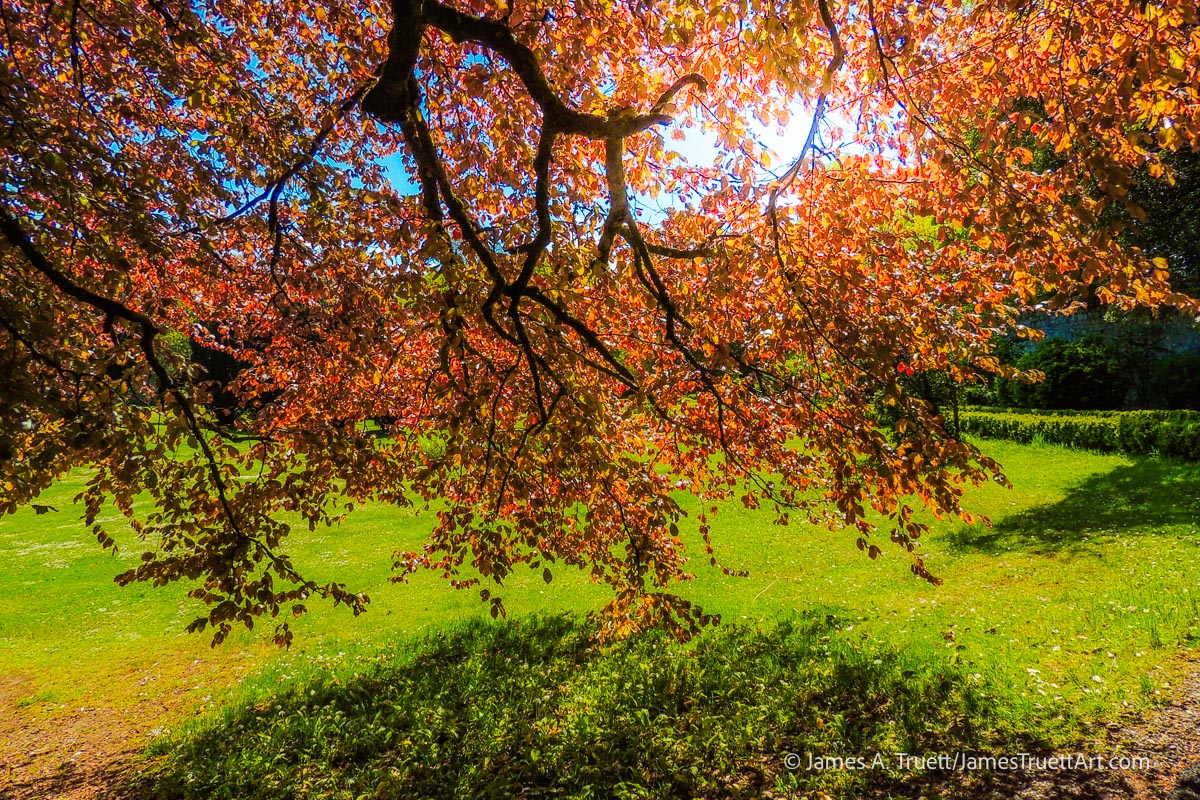
The Autograph Tree is the natural centrepiece of any visit to Coole Park.
In 1898, Lady Gregory asked Yeats to carve his initials into the trunk of a mature copper beech in the walled garden. Other guests followed. George Bernard Shaw, John Millington Synge, Seán O’Casey, Jack B. Yeats, Douglas Hyde and Lady Gregory herself are among the names identified on the tree.
Some initials are difficult to see now. The living bark has continued to grow and heal around them, which seems entirely appropriate. This is not a monument cut from stone and sealed against time. It is a living archive, changing as it preserves.
I have photographed the afternoon sun shining through its bronze leaves, an image I called Under the Autograph Tree, Coole Park, County Galway. Standing there, it is tempting to concentrate only on the famous names. But the tree also makes me think about the conversations we cannot recover—the jokes, disagreements, half-formed ideas and quiet moments beneath those same branches.

The Seven Woods—and a Difficult Change
The trails lead beyond the garden into the Seven Woods celebrated by Yeats. Here, ivy-laced trees stand beside old walls, mist lingers between trunks, and the forest floor changes with the season. Crocuses and violets appear early. Later come bluebells, wild garlic and the rich green layers that can make an Irish woodland seem illuminated from within.
These were some of my favourite places to walk and photograph, so what I encountered in 2015—the year of Yeats’s 150th birthday—came as a shock. Large areas had been cleared, leaving sections of the fabled woods raw and exposed. During a year devoted to celebrating a poet so closely associated with Coole, the timing felt painfully tone-deaf.
The history is more complicated than that first reaction allowed. From 1927 until 1987, the estate was managed by the Forest Service, and much of the land was planted with fast-growing exotic conifers for commercial timber. The cutting I saw in 2014–15 was part of a later programme to remove single-species commercial plantations and encourage native regeneration and biodiversity.
Understanding the purpose does not erase the shock of seeing a familiar woodland stripped back. Restoration can look like destruction in its early stages. Coole reminds us that conservation is not always visually gentle, and that a beloved landscape can carry several conflicting histories at once.

Quiet Still Wanders Here
Today, the Seven Woods Trail runs for 4.5 kilometres through woodland, past Coole Lake and wetlands, and alongside remnants of the estate’s built history. I enjoy the stonework and ruins almost as much as the celebrated landmarks. They reward the habit of looking to the side rather than hurrying toward the next destination.
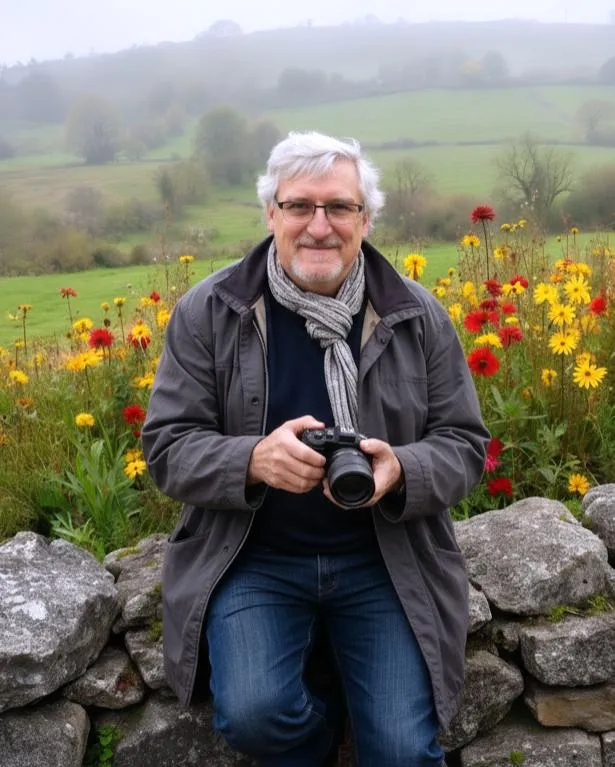
The walled garden offers a different kind of pleasure. It is enclosed without feeling formal, historic without becoming remote. I have visited with my cousins when summer flowers were in bloom, and I have watched the garden do what good public spaces do best: hold family gatherings, solitary wanderers, curious children and literary pilgrims without demanding that anyone experience it in the same way.
Coole Park is the subject of my photographic book Mystical Moods of Ireland, Vol. IV: In the Footsteps of W. B. Yeats at Coole Park and Ballylee. The book includes both places, but Coole has its own distinct story—one of hospitality, creative fellowship, loss and renewal.
I return in memory to the Autograph Tree. The house vanished. The woods were altered. The bark continued to grow around the letters.
That may be Coole Park’s quiet lesson. A place does not preserve its history by remaining unchanged. It carries the marks forward—some carved deliberately, some left by time—and asks us to look closely enough to see them.