What County Clare’s Abandoned Cottages Remember
In one abandoned home in the Irish countryside, sunlight pours through a tattered curtain and falls across an ornate hearth. The roof is failing, the room is empty, and the fire has long gone out. Yet it is easy to imagine this as the heart of the house: meals cooking, stories passing from one generation to the next, and an oil lamp holding back the County Clare night.
Whenever I see one of these cottages, curiosity and sadness arrive together. I wonder how many faces have peered through the windows, how many children played in the yard, and what joys, sorrows and celebrations unfolded beyond the weathered door. The walls remain, but most of the names and stories have disappeared.
These ruins are not simply picturesque features in the landscape. They are fragments of lives.

A Landscape Changed by Loss
It is tempting to call every old ruin a “Famine cottage,” but the truth is more complicated. Some homes were abandoned during the Great Famine. Others emptied in the long generations that followed, as people died, farms changed, and younger family members left for towns, cities or other countries. Some buildings remained occupied well into the twentieth century.
Together, however, they tell the larger story of rural depopulation.
County Clare had about 286,000 residents in 1841. By 1851, after the worst years of the Great Famine, that number had fallen to roughly 212,000. Records cited by Clare County Library indicate that more than 13,000 Clare homes became uninhabited during that decade. Emigration continued long after the potato crop recovered, and the county’s population fell much further before beginning its modern recovery. The 2022 census counted 127,938 people in Clare—still fewer than half the number recorded in 1841.
Numbers describe the scale, but an abandoned kitchen makes the loss personal.
My Family’s Road Away from Ireland
Emigration is not an abstract chapter of history in my family. My great-grandfather left Kilkenny with his mother and siblings in 1845. Half a century later, in 1895, my grandmother and most of her siblings also left Ireland for America.
They were searching for a better life, but beneath that familiar phrase was something more urgent: survival.
Today we can cross an ocean in hours and speak face to face through a screen. For those leaving Ireland in the nineteenth century, departure often carried a terrible finality. Many never again saw the parents, siblings, neighbours or landscapes they had known. A cottage left behind could become the last physical trace of a family’s life in Ireland.
That knowledge changes the way I look at these places. The broken doorway is not only an architectural detail. It is an interruption in a family story.

What the Flowers Remember
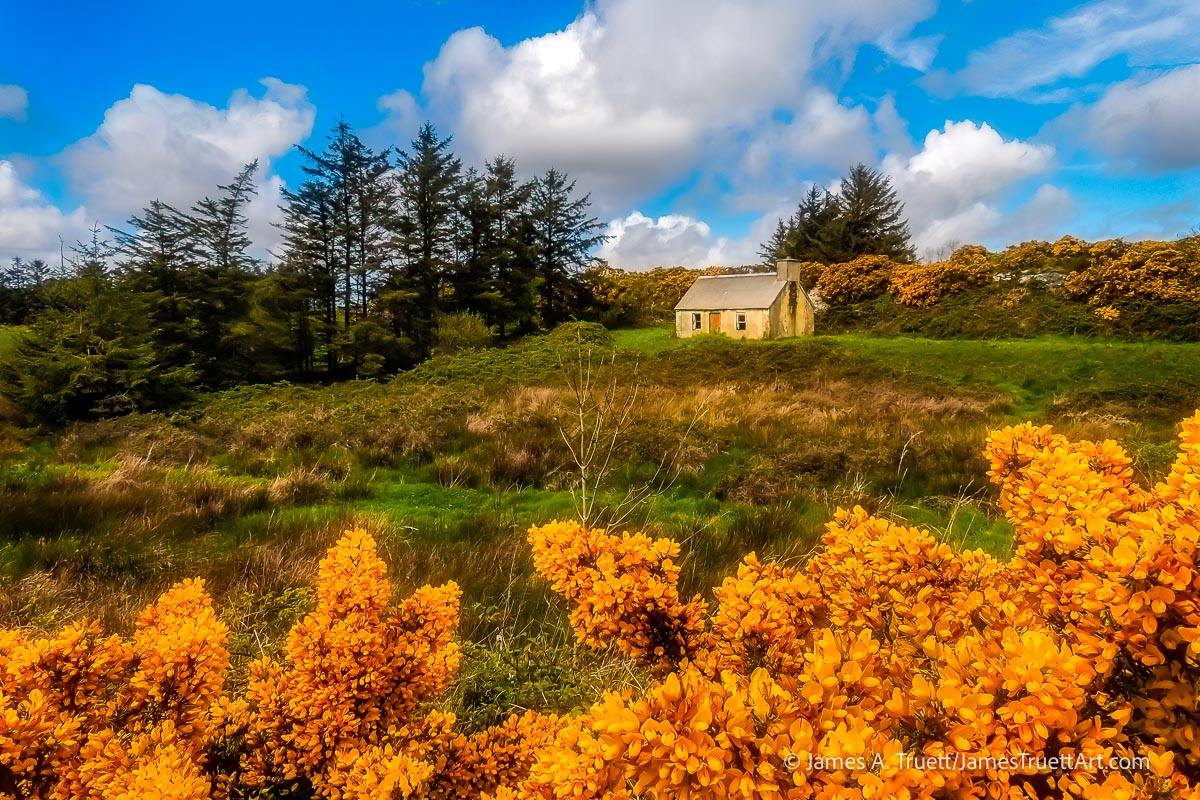
Nature does not leave the cottages empty. Ivy enters through the windows. Moss softens the stone. Roots take hold in the walls, while gorse, Montbretia, foxgloves and buttercups crowd the yards.
Near Kilrush, daffodils still return each spring in front of one ruined cottage. Their annual display is a poignant reminder of the lives once lived and families raised there. Elsewhere, flowers planted long ago continue to bloom after the people who tended them are gone. I find great irony and beauty in that: the human presence has vanished, yet the garden remembers its season.
On a recent outing with my cousin Frank, I photographed another abandoned Clare cottage surrounded by tall foxgloves and bright buttercups. The flowers softened the silence without erasing it. That balance—sorrow held beside beauty—is what keeps drawing me back.
Looking Through the Empty Windows
Doorways and windows have become recurring elements in my work because they allow two times to occupy one frame. The ruined wall belongs to the past; the landscape beyond it is alive now.
In several composite artworks, I have placed wildflower meadows, a luminous Burren landscape or the moving waters of the Wild Atlantic beyond the openings of abandoned cottages. The ruins cast a deep sadness from the past, while the sea and open countryside offer a sense of hope.
These images are imagined, but the feeling behind them is real. I am not trying to restore a lost history that I cannot know. I am asking the viewer to pause at the threshold and consider that this was once someone’s home.

When a House Lives Again
Not every story ends in collapse.
A former forge and home in the townland of Lanna, between Lissycasey and Ballynacally, was eventually removed and replaced by a new family house. In Clarecastle, a cottage I had photographed in abandonment was later restored and extended. It was wonderful to pass it again and see life returning.
The most memorable renewal I witnessed was on Horse Island in the Shannon Estuary near Kildysart. The island had 142 residents in 1841, but its last permanent residents left in 1976. Most of its houses fell into ruin. Fintan Ginnane and his son Fergal spent years rebuilding their ancestral home from little more than four roofless walls.
I joined more than 120 guests for the house blessing. There was food, music and dancing, but also a deliberate remembrance of the generations who had lived there. The gathering did more than rescue a building. For one afternoon, it joined the family’s past to its future.

The Stories Held in Stone
I still feel sadness when I encounter an abandoned cottage along a Clare boreen. I still imagine the turf fire, the lamplight and the children in the yard. I know that imagination cannot recover the names of the people who lived there, and I do not want to turn hardship into romance.
But looking closely is its own form of respect.
A tattered curtain, an old hearth, daffodils beside a roofless wall—each small detail reminds us that history did not happen only in castles, government buildings or battlefields. It happened in kitchens. It happened around fires. It happened when a family closed a cottage door and began a journey from which they might never return.
The walls may be silent, but they are not empty.